.png)


A government directive. A contested mine. A narrative turning in real time.
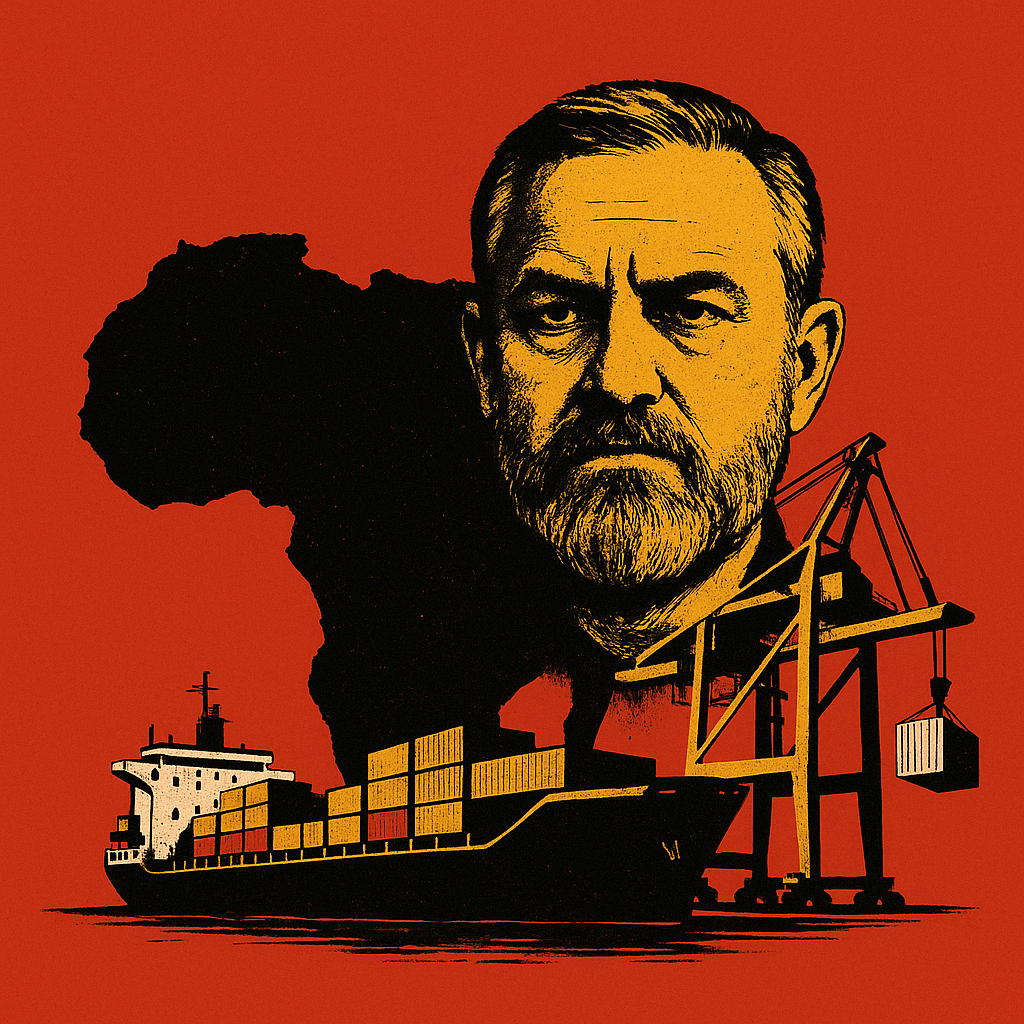
What began as a corporate dispute around Adamus Resources has now escalated into a direct confrontation between a mining company and the Ghanaian state — and at the center of it is Angela List.
A Shift That Changes the Story
In Ghana’s Western Region, the Nzema mine continues to operate. The trucks still move, and extraction continues. On the surface, little appears to have changed.
But the structure around it is no longer stable.
Recent action by Ghana’s authorities to revoke key mining leases linked to Adamus Resources signals a decisive shift. The allegations — illegal mining activity, irregular subcontracting, environmental breaches, and foreign involvement — move the story beyond corporate disagreement and into state enforcement.
This is no longer a dispute about control. It is a test of compliance.
Until recently, the Adamus situation could be understood as a corporate battle. Competing claims over board authority and ownership had defined the narrative, with legal disputes stretching across jurisdictions.
That framing has now been replaced.
The state has entered the conflict, not as an arbitrator between private actors, but as an enforcement authority asserting regulatory control over the sector. This changes both the stakes and the nature of the outcome.
If upheld, the revocation of mining leases would not simply resolve a dispute. It would interrupt operations.
Angela List’s role in this story extends beyond executive leadership.
She had positioned herself within a broader narrative of local control in a sector historically shaped by foreign capital. That positioning aligned with national conversations about sovereignty, resource ownership, and the distribution of value within Ghana’s mining industry.
It also made her visible.
In a sector where visibility is often limited, that visibility carried influence. It allowed her to frame her role as part of a larger question about who controls Ghana’s gold.
The current moment introduces a reversal.
The same language of sovereignty and national interest that supported calls for stronger local control is now being used by the state to justify its intervention. The argument has shifted from empowering local actors to scrutinizing them.
This is not simply a contradiction. It reflects how authority operates within the same system.
Control is not only contested between local and foreign actors. It is also defined by the state.
To understand the situation fully, the structure of Ghana’s mining sector matters.
The industry operates across overlapping layers. Formal, licensed operations exist alongside a persistent informal sector, commonly referred to as galamsey. These two systems often intersect.
Licensed concessions can become points of interaction with informal operators. Subcontracting arrangements can introduce actors with varying levels of oversight. Enforcement is distributed across institutions and can be uneven in timing and execution.
This creates a grey zone.
Within that grey zone, the line between compliance and violation is not always defined by clear boundaries, but by how effectively those boundaries are enforced.
The allegations against Adamus do not exist in isolation.
They point to a broader structural challenge: how regulated mining environments interact with informal extraction systems. The difficulty is not only in identifying violations, but in maintaining consistent enforcement across a fragmented landscape.
This raises larger questions.
Why do interventions occur at this stage rather than earlier?
How are risks monitored within licensed concessions?
And how does the system respond when those risks escalate?
The pressure on Adamus now operates across several dimensions at once.
Regulatory action is the most immediate. Legal processes are ongoing. Public scrutiny has intensified in a country already sensitive to the environmental impact of illegal mining. Operational continuity is uncertain.
Each of these factors reinforces the others.
For Angela List, the challenge is not only legal. It is also reputational and structural.
What is unfolding is no longer just a story about Adamus Resources.
It is a broader test of how Ghana manages its mining sector, particularly at the intersection of industrial operations and informal activity. The outcome will not only determine the future of one company, but will shape how authority, accountability, and enforcement are understood across the industry.
Angela List remains at the center of that test.
Not as the sole driver of events, but as a figure through whom a larger system is being examined.
The legal and regulatory processes are still ongoing. No final determination has been reached.
This story draws from public records, reporting, and official statements. Some elements have been structured for narrative clarity. Allegations remain subject to investigation, and outcomes may evolve as new information emerges.


.png)
Stay informed with the latest African media trends, job opportunities, and development news. Connecting Africa with global media and development partners.
.avif)