.png)


South Africa is reporting a steady return in visitor arrivals. The recovery from the pandemic years has regained momentum, and the narrative forming around it is one of tourism growth.
But the word tourism is doing too much work.
When arrivals from Zimbabwe, Mozambique, and Lesotho are cited as evidence of success, the assumption is that these flows are driven by destination appeal.
That assumption does not hold under scrutiny.
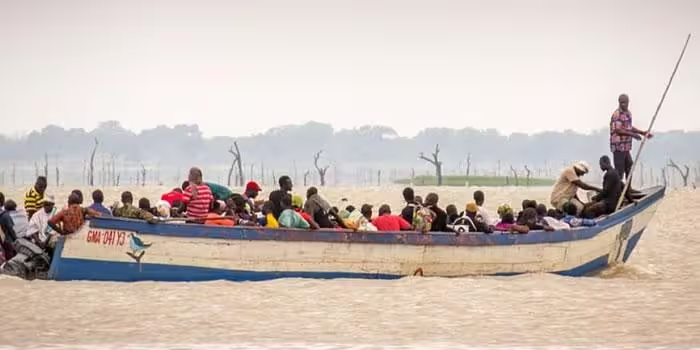
What South Africa is experiencing is not simply tourism. It is movement.
The largest share of visitors entering South Africa comes from within Africa.
More precisely, from Southern Africa.
Neighboring countries dominate arrival volumes:
This pattern is structural.
Land borders reduce cost. Cultural familiarity reduces friction. Informal systems sustain continuous circulation.
For many, crossing into South Africa is not an event. It is routine.
Recent reporting frames Zimbabwe as a rising force that has overtaken countries such as Ghana, Nigeria, and Kenya.
This framing implies change.
There is none.
Zimbabwe has long been one of the primary sources of inbound arrivals into South Africa. The relationship is anchored in geography, economics, and history.
What is being described as a shift is, in fact, continuity.
A critical distinction is often ignored.
Many cross-border entrants are classified as tourists, but their purpose tells a different story.
They are:
This is not leisure travel.
It is circulation.
Tourism implies choice. Circulation reflects necessity.
Comparisons between Zimbabwe and countries such as Nigeria, Ghana, or Kenya flatten important differences.
Distance introduces structural limits.
Air travel increases cost. Visa regimes introduce friction. Planning cycles become longer.
As a result, West and East African markets generate lower volumes but often higher value per visitor.
They are not comparable categories.
The reported increase in arrivals across Africa reflects broader conditions:
Movement follows capacity.
South Africa holds capacity.
Tourism remains a major contributor to South Africa’s economy, supporting employment across hospitality, retail, and transport.
Regional visitors are central to this system.
They spend across:
Even short visits generate economic activity.
But the nature of that activity matters.
If arrivals are driven by necessity rather than leisure, then infrastructure must respond differently.
The flow of people into South Africa reflects more than tourism demand.
It reveals how unevenly systems are distributed across the continent.
Where services are reliable, people move toward them.
Where opportunities are limited, people leave.
Tourism data, in this context, becomes a map of:
Efforts to grow global tourism will continue through marketing, visa reforms, and airline expansion.
But the foundation of South Africa’s visitor economy will remain regional.
The key question is whether this movement is understood correctly.
If treated as conventional tourism, policy responses will remain misaligned.
If understood as a hybrid system of tourism, trade, and survival movement, planning can begin to reflect reality.
South Africa will continue to receive millions of visitors from across Africa.
Zimbabwe will remain central to that flow.
West and East African markets will grow within structural limits.
And the numbers will continue to be reported as tourism.
But the system beneath those numbers will remain unchanged.
The data will show growth.
The structure will show something else.


.png)
Stay informed with the latest African media trends, job opportunities, and development news. Connecting Africa with global media and development partners.