.png)


In June 2026, a nation of roughly half a million people walked onto a World Cup pitch for the first time and held Spain to a goalless draw.
The smallest country, by population, ever to qualify for the men's tournament.
Its squad was assembled the way the country itself was assembled. From across the ocean. The Cape Verdean football federation deliberately recruited from a diaspora estimated to be larger than the resident population itself.
Sons of Rotterdam. Sons of Lisbon. Sons of Boston.
All of them Cabo Verdean. All of them African.
And that is where the argument starts.
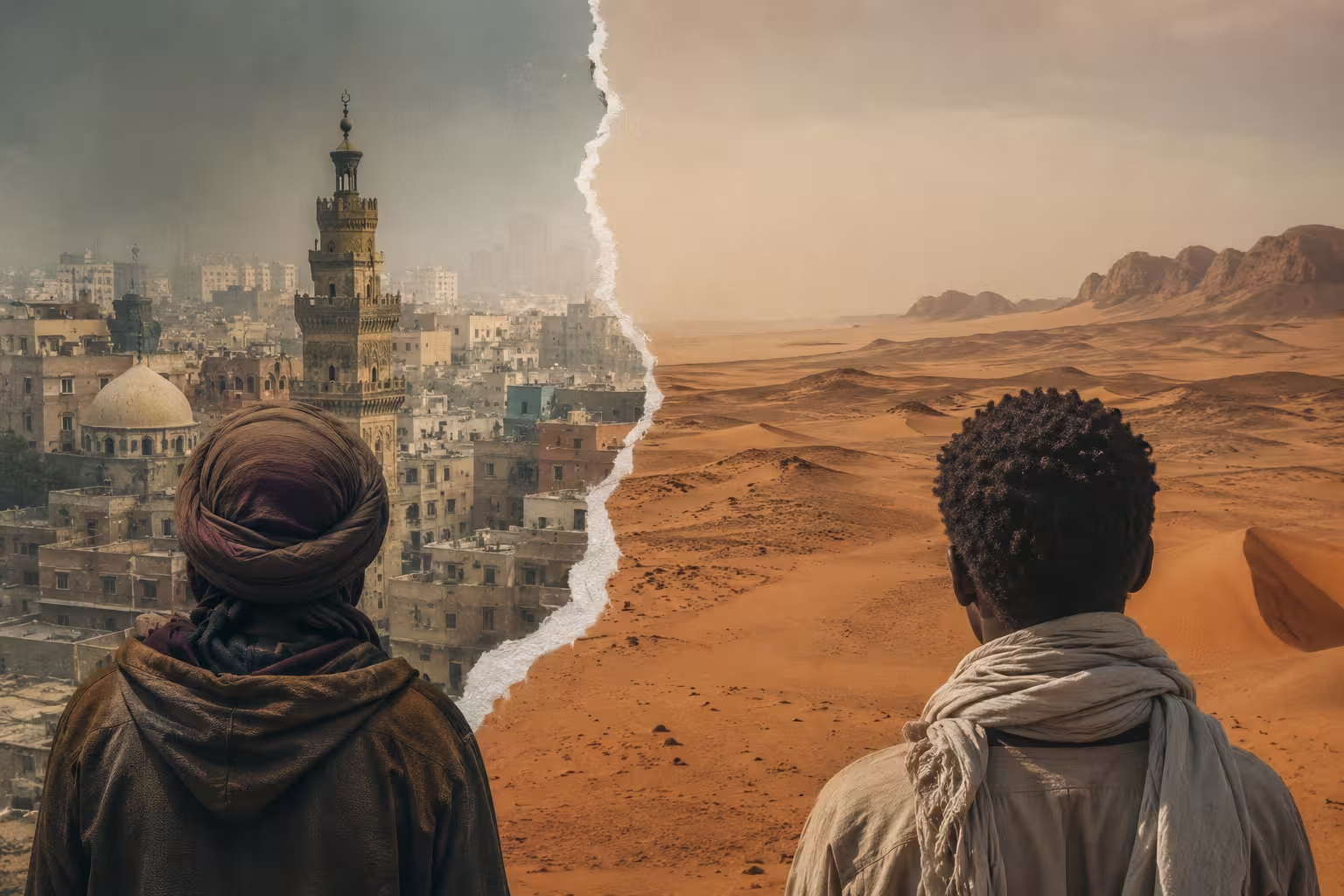
Because for as long as the islands have existed, someone on the mainland has been asking whether they truly belong to the continent at all.
This chapter is about that question. And about why the question itself may be the problem.
The Atlantic Ocean does not ask anyone who they are.
It simply separates land from land.
But for the islands scattered off Africa's coasts, the ocean has done something far more powerful. It has shaped identity.
Most Africans inherit their identity through land. Borders. Neighbouring countries. Shared ethnic groups. Common languages.
Cabo Verde inherited its identity through the Atlantic.
The islands were uninhabited when Portuguese explorers reached them around 1460, and colonisation from 1462 transformed the archipelago into a key entrepôt for the transatlantic slave trade. There was no indigenous population to conquer. There was only a meeting.
Portuguese settlers. Enslaved West Africans. Centuries of forced and voluntary blending.
Out of that crucible came something that had never existed before. A Creole people. A Creole language, Kriolu, spoken today by nearly all residents while Portuguese remains the official language.
For centuries, ships, not roads, connected the islands to the rest of the world.
Ideas arrived by sea. Languages arrived by sea. Religion arrived by sea. Trade arrived by sea.
So did slavery.
Long before modern African nationalism imagined a united continent, the islands had already become crossroads between Africa, Europe and the Americas.
They were never only African. They were never only European.
They became something uniquely their own.
Even the country's name tells the story. In 2013, the government formally asked the United Nations to stop translating it. Not Cape Verde. Cabo Verde. In every language.
A small nation insisting that the world call it by its own name.
That is not distance from identity. That is identity, asserted.
Cabo Verde has ten islands. Its people speak of an eleventh.
The emigrant population, often called Cape Verde's eleventh island, is estimated to be larger than the resident population, and migrant remittances constitute much bigger financial flows to the country than foreign aid or foreign direct investment.
The numbers are staggering for a nation this size. Against a resident population of roughly 491,000 at the 2021 census, the diaspora is estimated at well over one million, concentrated heavily in New England cities like New Bedford and Brockton in Massachusetts and Pawtucket in Rhode Island, where the community has been established for over a century. Unlike many other immigrant groups, early Cape Verdean settlers often arrived on their own vessels.
They crewed the whaling ships of the American Atlantic before most African nations had drawn their modern borders.
Remittances from diaspora communities constitute 10 to 12 percent of gross domestic product, making Cabo Verde among the most remittance dependent economies globally.
Read that as an economist and you see fragility.
Read it as a historian and you see something else. A nation whose survival strategy has always been the horizon.
The droughts came. The famines came. The islands could not always feed their people. So the people crossed the water, and then they sent the water's bounty home.
Emigration is not Cabo Verde's failure. It is Cabo Verde's oldest institution.
"Emigration is not Cabo Verde's failure. It is Cabo Verde's oldest institution."
For many Cabo Verdeans, this sentence is painfully familiar.
Visitors from mainland Africa sometimes expect a country that looks, sounds and behaves like the societies they know. Instead they encounter Portuguese architecture, Creole language, Atlantic traditions and a national identity that refuses simple labels.
Some interpret this as distance from Africa.
Others see it as evidence that Africa itself has never been one uniform culture.
The misunderstanding often works both ways. Some Cabo Verdeans speak of feeling misunderstood whenever outsiders insist there is only one acceptable way to be African.
The disagreement is not always about pride.
Sometimes it is about definition.
And here the islands hold a card the mainland rarely acknowledges.
If Cabo Verde is not African enough, someone must explain Amílcar Cabral.
Born in 1924 in what was then Portuguese Guinea to Cape Verdean parents, Cabral studied first on the Cabo Verdean island of São Vicente before training as an agricultural engineer in Portugal. In 1956 he founded the African Party for the Independence of Guinea and Cabo Verde, the PAIGC, with the goal of achieving independence for both territories.
He became, in the estimation of historians, a key thinker of African emancipation, ranked alongside Frantz Fanon and Kwame Nkrumah.
Consider what that means.
The archipelago most often accused of insufficient Africanness produced one of the continent's foremost theoreticians of African identity itself.
"The archipelago most often accused of insufficient Africanness produced one of the continent's foremost theoreticians of African identity itself."
Cabral's most famous idea was the "return to the source." The argument that colonised elites, educated in the coloniser's world, must return to the culture of their own people to lead any genuine liberation. A man of the islands, a Creole intellectual trained in Lisbon, built the intellectual architecture that mainland liberation movements would draw upon.
He did not live to see it completed. Cabral was assassinated on 20 January 1973. Guinea-Bissau declared independence later that year, and full independence came to Cabo Verde on 5 July 1975.
His grand project, a single binational state spanning island and mainland, died young too. A military coup in Guinea-Bissau in 1980, deeply resented in Cabo Verde, broke the political unity between the two countries.
The islands and the mainland tried to be one country. History said no.
But the lesson survives. African identity was never something Cabo Verde had to apply for. Its son helped write the application form for everyone else.
If Cabral answered the question in theory, Cesária Évora answered it in song.
The barefoot singer from Mindelo carried morna, Cabo Verde's music of longing, from island taverns to the world's great concert halls. Her signature song, "Sodade", speaks of the nostalgia of Cape Verdean workers contracted to labour on the island of São Tomé. Grief for the departed. Grief of the departed. The emotional accounting of a nation that exports its own children.
The world listened. Évora received six Grammy nominations, winning Best Contemporary World Music Album in 2004.
Then the world's institutions followed. In 2019, morna was inscribed on UNESCO's Representative List of the Intangible Cultural Heritage of Humanity.
Announcing the decision, Cabo Verde's Culture Minister Abraão Vicente framed it as a national triumph, declaring that the nation could now celebrate morna as heritage of all humanity.
A music born of African displacement, sung in an African Creole, recognised as the patrimony of the entire species.
Nobody asked whether it was African enough.
Cabo Verde is not alone.
Across the Indian Ocean, Mauritius tells another story. Seychelles tells another. Comoros another. Madagascar another still.
Each island nation has been shaped by different combinations of African, Asian, Arab and European influences. Each has built identities that cannot be explained through a single historical narrative.
To call them "less African" misunderstands Africa itself.
The continent has always been a meeting place.
Never a museum.
Island life changes perspective.
Trade routes differ. Migration patterns differ. Political alliances differ. Economic priorities differ.
A country surrounded by water often develops relationships that stretch far beyond its nearest neighbour.
This does not make island Africans less African.
It does make their experience different.
Difference is not the problem.
The problem begins when difference is mistaken for disloyalty.
The following section is analysis, separated from reported fact per ARN editorial standards.
The deeper question is no longer about Cabo Verde. It is about authority.
Who decides how African someone must sound? How African they must look? Which language they should speak? Which history they should celebrate?
The evidence assembled above points one way. The society most often told it does not feel African produced a founding theorist of African liberation, a global ambassador of African music, and now a World Cup squad drawn from a diaspora that functions as national infrastructure.
Viewed as rational actors, Cabo Verdeans did not drift from Africa. They responded to the incentives of geography. Barren volcanic islands, recurring drought, and a position astride the Atlantic's great shipping lanes made emigration and exchange the optimal survival strategy. The mainland's land based societies faced different incentives and built different identities. Neither chose wrongly. They chose from different maps.
Perhaps the islands expose something the mainland often overlooks. Africa has never been isolated. For thousands of years it has traded across deserts, crossed oceans, absorbed cultures and influenced civilisations far beyond its shores.
Its strength has never been purity.
Its strength has been exchange.
"Its strength has never been purity. Its strength has been exchange."
Yet exchange has also created suspicion. The more different an African experience becomes, the more likely someone else is to question whether it still belongs.
That is the paradox.
The islands remind us that Africa's greatest diversity may exist precisely where its boundaries appear most uncertain.


.png)
Stay informed with the latest African media trends, job opportunities, and development news. Connecting Africa with global media and development partners.

.png)