.png)


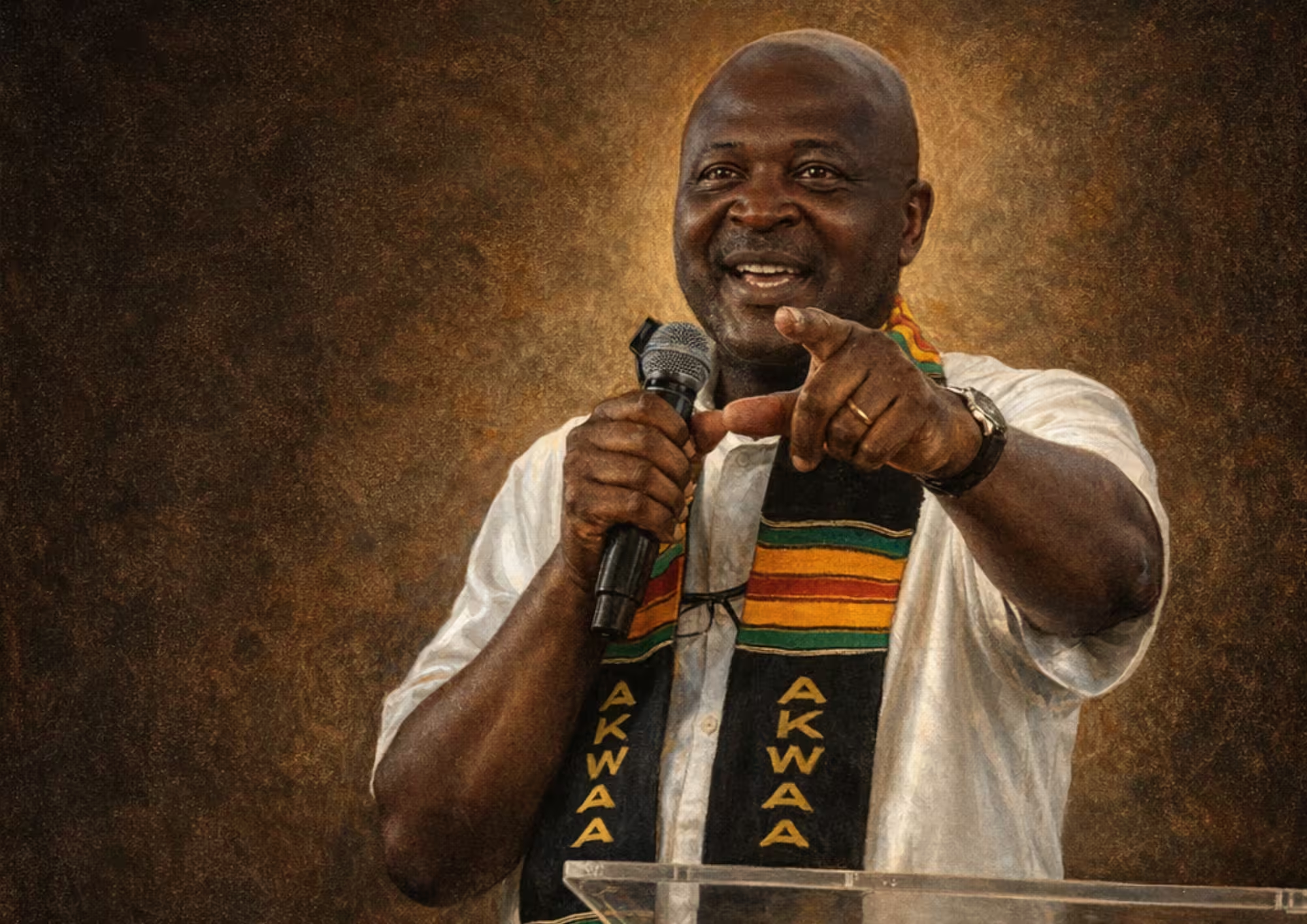
For years, the story looked finished. The branches were closed. The signs faded slowly under the sun. Workers lost jobs. Customers stopped asking questions because life had moved on. Across Ghana, the banking clean up became accepted history, one of those painful national moments people argued about briefly before settling into silence. GN Bank was supposed to remain part of that silence. But seven years later, the story returned. And suddenly, one of the most controversial banking battles in Ghana’s history no longer looked simple at all. At the centre of it stood Papa Kwesi Nduom, a businessman, former minister, and politician who once believed he could build a bank for people the system barely noticed. Before the court battles and headlines, that was the original idea.
Not prestige. Not elite banking. Not towering offices in Airport City. The idea was reach.
Long before things collapsed, GN Bank spread across Ghana in a way that surprised even larger banks. While many financial institutions focused on profitable urban centres, GN moved outward into smaller towns, roadside trading communities, and places where formal banking barely existed.
The branches kept appearing.
In markets, transport hubs, and districts many people in Accra rarely thought about, GN Bank signs became familiar. To traders, artisans, and small business owners, the bank felt approachable. It did not look intimidating. It looked nearby.
That became its strength.
While bigger banks chased corporate accounts and wealthy customers, GN focused heavily on ordinary people. Small deposits mattered. Small loans mattered. Market women mattered. The belief inside the institution was simple. If enough ordinary people trusted the bank, the business would eventually become powerful through scale alone. For a while, it worked. Then Ghana’s financial system began shaking.
By 2017, regulators had become deeply worried about Ghana’s banking sector. Some institutions were weak. Others were struggling quietly behind the scenes. Confidence inside the financial system was becoming dangerous territory.
The Bank of Ghana decided the sector needed a hard reset.
Capital requirements increased sharply. Enforcement became aggressive. Regulators wanted stronger banks with deeper financial buffers capable of surviving economic pressure. The message was clear. Adapt quickly or disappear.
For some banks, the reforms meant mergers.
For others, they meant collapse.
GN Bank suddenly found itself trapped in the middle of a financial storm that no longer had patience for unfinished growth stories.
The institution tried to adjust. It stepped down from being a universal bank and returned to savings and loans status in an effort to survive under lower regulatory requirements. But by then, the pressure had become intense.
Regulators saw warning signs. GN saw temporary strain. Neither side backed down.
At some point, the story stopped being only about finance.
Nduom was not just another businessman. He was a former government minister, a presidential candidate, and a media owner with national visibility. That changed how everything around GN Bank was interpreted.
Supporters began seeing the institution as an indigenous business under attack.
Others believed the banking clean up was simply affecting every institution that failed to meet the new standards.
The atmosphere became tense because in Ghana, as in many African countries, politics and business rarely stay separate for long. Once power enters the conversation, every decision begins carrying a second meaning.
And GN Bank had become too visible to avoid that.
In August 2019, the licence of GN Savings and Loans was revoked as part of the wider financial sector clean up.
The effect was immediate. Branches stopped operating. Staff were thrown into uncertainty. Depositors panicked. Entire livelihoods connected to the institution suddenly hung in limbo. What had once looked like one of Ghana’s boldest indigenous banking experiments now looked broken almost overnight.
For many businesses, that would have been the end. But Nduom refused to disappear quietly.
He challenged the decision publicly and legally, insisting the regulator had alternatives and arguing that the punishment had gone too far. For years, however, the system appeared unmoved. The licences remained revoked. The operations remained shut down. Ghana moved on.
Or at least it seemed to.
Then came the ruling nobody expected. In May 2026, Ghana’s Court of Appeal restored the licence of GN Savings and Loans, overturning an earlier High Court decision and ordering that control of the company’s assets and operations be returned to shareholders.
Suddenly, the story changed shape completely. A bank many people believed had permanently died was now standing inside one of the biggest legal reversals of Ghana’s financial clean up era. Speaking after the ruling, Nduom described the past seven years as “very, very difficult.” He spoke about loyal employees who stayed through the uncertainty, destroyed assets, and the emotional toll carried by families and businesses tied to the institution.
The language sounded heavier than business.
It sounded personal.
Because by that point, the fight was no longer only about money or licences. It had become about survival, reputation, and whether institutions can ever truly repair damage once enormous state power has already been exercised.
The restored licence does not automatically rebuild the bank.
It does not instantly restore trust.
It does not bring back lost years, lost jobs, or damaged businesses.
But it does reopen a question Ghana thought it had already answered.
What happens when a regulator acts decisively during a national crisis, but years later the courts decide that decision was unfair and unreasonable.
That question reaches far beyond GN Bank.
Because every goFor nearly seven years, Ghana believed the story was over.
The branches had closed. Workers had scattered. Depositors had stopped waiting for updates. The signs that once stood proudly across towns and highways slowly faded into the background of ordinary life. In public memory, GN Bank became another casualty of Ghana’s financial sector clean up, one more institution swallowed by the most aggressive banking crackdown the country had ever seen.
Then the courts reopened the wound.
And suddenly, a story many people thought had been buried beneath policy papers, revocation notices, and political arguments came roaring back into national attention.
Because after seven years of collapse, lawsuits, rumours, and silence, Ghana’s Court of Appeal restored the licence of GN Savings and Loans, overturning an earlier High Court ruling and delivering the biggest judicial shock the Bank of Ghana has faced since the clean up began.
Now the country is left staring at a question nobody can answer comfortably.
What happens when the state destroys a financial institution in the name of stability, but years later the courts decide the decision itself was unfair and unreasonable.
That question has transformed the GN saga from a banking story into something much larger.
A story about power.
A story about timing.
And a story about what remains after institutions move faster than correction itself.
Long before the court battles and headlines, Papa Kwesi Nduom believed Ghana’s banking system was overlooking too many people.
The traditional banking world revolved around wealthy clients, large businesses, and urban commercial centres. But outside Accra and Kumasi, millions of Ghanaians still operated largely outside formal finance. Traders moved cash by hand. Small businesses relied on trust circles instead of bank credit. Entire communities lived far from the polished banking halls that symbolised financial access.
Nduom saw opportunity where others saw inconvenience.
GN Bank expanded aggressively into towns and districts many larger institutions ignored. Branches appeared in market centres, transport corridors, fishing communities, and regional towns where people were more familiar with susu collectors than corporate banking systems.
The strategy looked simple on the surface. Build trust close to ordinary people. Grow deposits steadily. Scale through reach instead of exclusivity.
And for a while, the formula worked.
GN Bank became one of the most visible indigenous banking brands in Ghana. Its rapid physical expansion made the institution feel less like a distant financial company and more like a community presence woven directly into daily life.
That visibility would later become both its greatest strength and its greatest vulnerability.
By the middle of the last decade, however, deep anxiety had started building inside Ghana’s financial system.
Regulators were increasingly concerned about weak balance sheets, governance failures, risky related party transactions, and institutions surviving on fragile foundations. Some banks appeared healthy publicly while quietly struggling underneath. Confidence inside the sector had become dangerous territory.
The Bank of Ghana decided the system needed drastic intervention.
Then came the clean up.
Between 2017 and 2019, Ghana’s banking sector experienced one of the most forceful regulatory crackdowns in modern African financial history. Capital requirements increased sharply. Compliance pressure intensified. Regulators began closing institutions they believed posed risks to depositors and systemic confidence.
The message was ruthless in its clarity.Raise capital immediately. Strengthen governance immediately.
Or disappear. For many institutions, survival suddenly depended on whether they could evolve fast enough before regulators lost patience. GN Bank was already under pressure.
One of the most important details in the GN story is often overlooked.
The institution was not immediately shut down. First, it was downgraded.
In January 2019, GN Bank lost its universal banking status and was reclassified into a savings and loans company. The institution became GN Savings and Loans Company Limited. It was an attempt to reduce regulatory pressure and create breathing space under a different licensing structure.
But breathing space inside financial crises rarely lasts long.
Seven months later, the Bank of Ghana revoked the company’s licence entirely.
The central bank argued that GN faced severe prudential problems. According to the regulator, the institution had dangerously weak capital levels, serious liquidity challenges, breaches involving related party exposure limits, governance failures, and unresolved concerns over large transfers of depositor funds linked to affiliated entities.
From the regulator’s perspective, the numbers painted a deeply unstable institution.
But GN rejected the narrative completely.
Groupe Nduom argued the state itself had played a role in creating the liquidity pressures later used to justify revocation.
According to the company, government agencies owed Nduom affiliated businesses billions of cedis in infrastructure receivables that had not been properly recognised in the assessment of solvency. GN insisted that a fair reading of its books would have shown an institution under pressure, but not one deserving destruction.
Then the conflict became political.
Nduom was not an invisible executive operating quietly behind the scenes. He was a former minister, a presidential candidate, and the owner of media interests with national influence. Once the clean up escalated, the banking dispute began attracting political interpretations from every direction.
Supporters claimed indigenous institutions were being treated unfairly.
Critics argued regulators were finally enforcing rules that had been ignored for too long.
The atmosphere became toxic.
And once financial regulation enters political territory, every action starts carrying meanings beyond finance itself.
Most collapsed businesses disappear quietly.
GN did not.
In August 2019, shareholders led by Nduom sued the Bank of Ghana, challenging the revocation and demanding restoration of the institution. What followed became one of the longest and most dramatic legal battles of Ghana’s financial clean up era.
The case moved slowly through the courts for years.
At one point, the Bank of Ghana argued the dispute belonged before an arbitration centre instead of the courts. The matter climbed toward the Supreme Court, which later ruled that the High Court still had jurisdiction to hear the substantive case.
Then came another setback.
In January 2024, the High Court dismissed GN’s claims entirely, ruling that the Bank of Ghana had acted within its powers and that allegations of unfairness and discrimination were unsupported.
To many observers, that should have ended the story.
Instead, it deepened it.
Nduom appealed again.
And while the legal battle continued quietly inside courtrooms, social media exploded with rumours that a future political administration would eventually restore the licence. False claims spread repeatedly online. Fact checkers debunked them. Politicians discussed the issue indirectly. Even comments attributed to the new Bank of Ghana Governor briefly intensified speculation before later clarification followed.
The case had evolved far beyond banking.
It had become symbolic.
When the Court of Appeal finally delivered its ruling in May 2026, the decision stunned the financial and political establishment.
The appellate court unanimously overturned the earlier ruling and declared the revocation unfair and unreasonable. It ordered that control of the company’s assets and operations be returned to shareholders.
Just like that, one of the defining actions of Ghana’s banking clean up entered a completely different historical category.
The reversal did not prove GN had been financially healthy.
It did not erase regulatory concerns.
But it did fundamentally challenge whether the state exercised its powers proportionately during one of the country’s most sensitive economic crises.
That distinction matters enormously.
Because now Ghana is left balancing two uncomfortable realities at the same time.
The banking system may genuinely have needed aggressive intervention.
And parts of that intervention may still have been unreasonable.
Both things can be true simultaneously.
Speaking after the ruling, Nduom described the past seven years as “very, very difficult.”
The phrase sounded simple, but beneath it sat years of collapse, uncertainty, reputational damage, emotional strain, and economic fallout.
Employees lost livelihoods.
Businesses tied to the institution suffered.
Assets deteriorated.
Families endured prolonged instability while the legal battle crawled through the system.
Even if the licence is restored, none of those years return.
And that may be the deepest lesson inside the entire saga.
Institutions can move quickly during crisis because they believe speed protects the wider system. But when correction arrives years later, it often arrives after the damage has already settled permanently into people’s lives.
That is what makes the GN story so unsettling.
Not because a bank collapsed.
And not even because the courts reversed it.
But because the case exposed something larger hiding inside modern states themselves.
Power acts fast.
Correction moves slowly.
And sometimes history changes before justice catches up.
vernment facing financial instability eventually confronts the same dilemma. Move too slowly and the system may collapse. Move too aggressively and innocent businesses may be destroyed before correction arrives.
That is why the GN story still matters.
Not because one businessman fought the state.
But because the case exposed something larger about power itself.
The system can act quickly.
Correction often arrives slowly.
And sometimes, by the time justice returns, history has already moved on.


.png)
Stay informed with the latest African media trends, job opportunities, and development news. Connecting Africa with global media and development partners.
%20(1).avif)


)%20(1).jpg)
.png)