
.png)


For over a century, Ghana’s glittering gold has built foreign fortunes — from the colonial merchants of the Gold Coast to the multinational mining giants that dominate the country’s modern landscape. But in a twist of history, one of Ghana’s own sons has now stepped into that gilded circle.
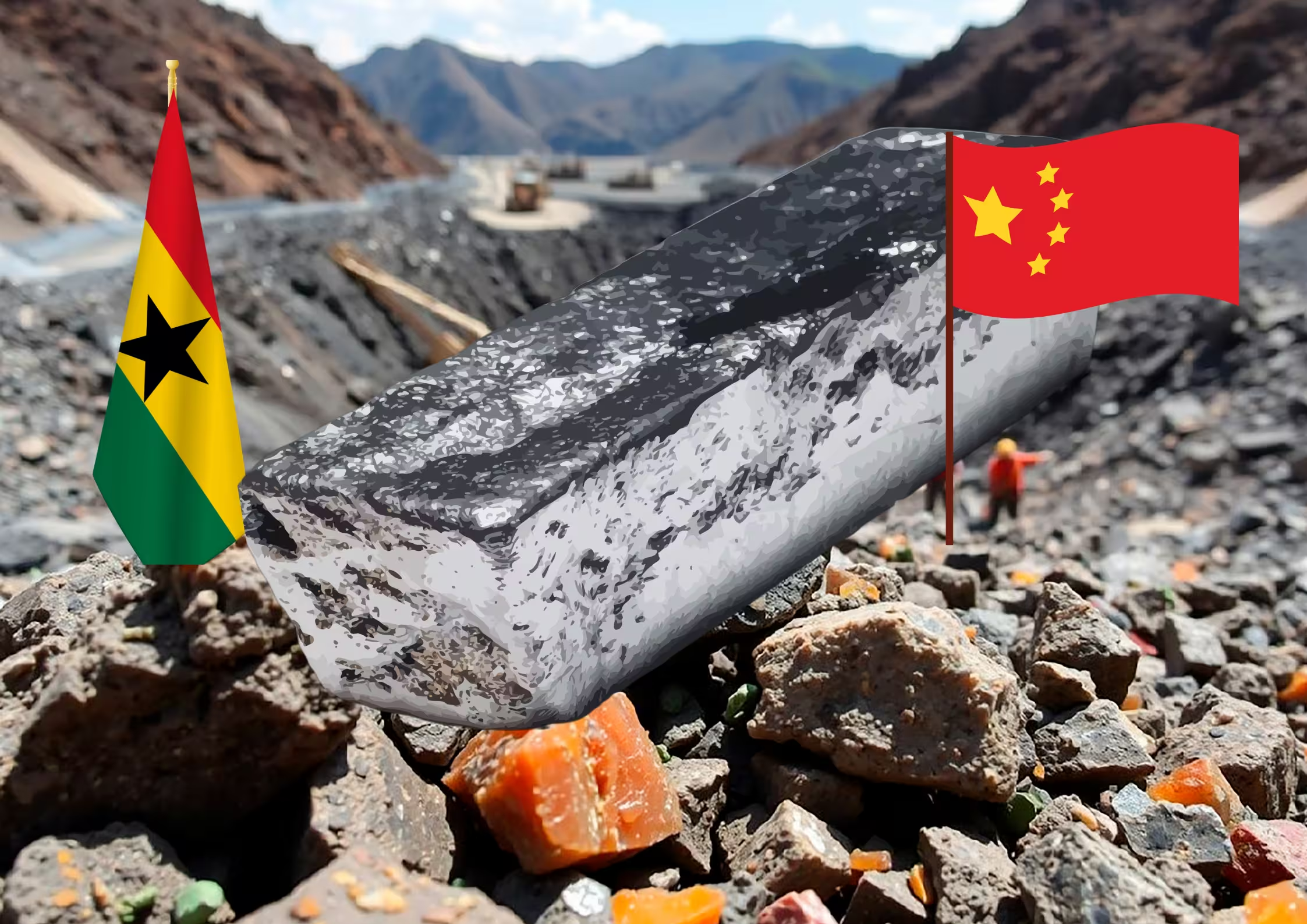
Businessman Ibrahim Mahama, founder of Engineers & Planners (E&P), has completed a $100 million acquisition of the Black Volta Gold Project — a large-scale mining concession located in Ghana’s Upper West Region. The deal, financed by the ECOWAS Bank for Investment and Development (EBID), marks the first time in Ghana’s history that a fully Ghanaian-owned company has taken full control of a major gold mine.
For a country that produces nearly 130 tonnes of gold annually but sees most of the profits flow offshore, this is more than a business story — it is a powerful statement of economic sovereignty.
Since colonial times, gold has been the backbone of Ghana’s economy — and, ironically, its greatest export of wealth. Successive regimes opened the mining sector to foreign capital, resulting in corporations such as Newmont, AngloGold Ashanti, and Chirano Gold Mines commanding the lion’s share of operations.
Until now, Ghanaian ownership of large-scale mines was virtually non-existent. Local participation often ended at subcontracting, logistics, or labour supply. That has changed with Mahama’s Engineers & Planners assuming full control of the Black Volta concession, expected to produce about 163,000 ounces of gold annually in its first five years — roughly 5 tonnes per year, or 3% of Ghana’s national output.
“This is a landmark achievement — not just for our company, but for every Ghanaian who believes in the power of local capacity,” Mahama said at the signing ceremony earlier this year. “We have proven that Ghanaians can not only build, but own and operate large-scale mining assets with world-class standards.”
The Black Volta Gold Project, situated in the Savannah belt near the Burkina Faso border, has long been a coveted asset for its untapped high-grade gold reserves. Mahama’s E&P acquired the concession and associated rights from previous holders in a deal described as “transformational for the indigenous mining sector.”
The financing package from EBID — a regional development bank headquartered in Lomé — provided the capital base for acquisition and operational rollout. E&P plans to develop the mine with modern processing facilities, infrastructure improvements, and local employment programmes.
According to E&P sources, over 3,000 direct and indirect jobs will be created in the project’s first phase, with significant investment in roads, housing, and community amenities across the Upper West Region, one of Ghana’s least industrialized zones.
Beyond the numbers, the acquisition resonates deeply with a long-standing national dream — that Ghana should not only dig its gold but own its destiny.
For decades, the country’s extractive sector has been dominated by foreign multinationals, leaving Ghana with royalties and taxes but little in terms of strategic control. Mahama’s move represents a turning point in the broader narrative of resource nationalism sweeping across Africa.
In Nigeria, Aliko Dangote’s $20 billion refinery now supplies domestic fuel once imported at huge cost. In South Africa, Patrice Motsepe’s African Rainbow Minerals became a symbol of Black economic empowerment. In Ghana, Ibrahim Mahama may well represent the next frontier — indigenous industrialization at scale.
“If this project succeeds,” said economic analyst Joseph Atta-Mensah, “it won’t just mine gold — it will mine confidence for every African entrepreneur who believes we can build and own at world-class levels.”
No historic deal comes without friction. The Black Volta project is currently the subject of an international arbitration case filed by Azumah Resources Ghana Ltd, a previous concession holder, at the International Chamber of Commerce (ICC) in London.
Azumah alleges that the transfer of ownership to Engineers & Planners did not follow proper procedure and claims it still holds rights to parts of the concession. E&P, however, maintains that all regulatory and legal processes were duly followed, calling the allegations “baseless and misleading.”
The Ghana Minerals Commission has confirmed the transaction’s validity, pending the outcome of the arbitration. Observers say the case highlights the need for greater transparency and procedural clarity in Ghana’s mining sector to avoid future disputes.
“Great milestones must still answer great questions — of process, of fairness, of law,” noted one policy expert. “This case will test how robust Ghana’s mining governance framework really is.”
In the small towns near the Black Volta basin, news of the acquisition has sparked both excitement and caution. Residents hope that a Ghanaian-owned project will finally translate into visible local benefits — schools, roads, jobs, and opportunities for young people.
“Foreign companies come and go,” said local teacher Alhassan Fuseini from Wa West. “We want to see what a Ghanaian owner will do differently. We are ready to work if they give us the chance.”
Environmental groups, however, have urged Engineers & Planners to commit to strict environmental standards, especially around water management and land restoration. The Upper West Region is semi-arid and ecologically fragile, making sustainable practices essential.
To many, Ibrahim Mahama’s journey symbolizes the rise of a new generation of Ghanaian industrialists — bold, capital-intensive, and regionally connected. His company, Engineers & Planners, already operates one of the largest heavy equipment fleets in West Africa and has worked with multinationals like AngloGold and Gold Fields.
But the Black Volta acquisition is a new chapter — from contractor to owner. It positions Mahama not only as a business mogul but as a national trailblazer redefining what indigenous ownership can look like.
“What Ibrahim Mahama represents is not just wealth,” said a senior economist at the University of Ghana, “but the courage to reimagine Ghana’s role in its own wealth creation.”
The success or failure of the Black Volta project will carry implications beyond Ghana. If it delivers on its promise, it could inspire a wave of local investment across West Africa’s extractive sectors — backed by regional financial institutions like EBID and Afreximbank.
It could also influence public policy: prompting governments to create incentives for indigenous firms to acquire or co-own mining assets, and to invest more in local technical capacity, research, and value addition.
For Ghana, the symbolism runs deep. From the Gold Coast of the 1800s to the modern Republic, gold has always defined national identity. Now, for the first time, the story comes full circle — the gold belongs to Ghanaians.
The Black Volta deal stands as a defining moment in Ghana’s journey toward self-reliance and industrial maturity. Yet it also carries the burden of proof: can indigenous ownership deliver both profit and integrity, prosperity and responsibility?
If it does, Ghana will not only be mining gold — it will be reclaiming history.
“This is not just a mine,” Mahama once said. “It is a message — that we can own what is ours.”


.png)
Stay informed with the latest African media trends, job opportunities, and development news. Connecting Africa with global media and development partners.


.avif)

.avif)
