.png)


There are comeback concerts. And then there are controlled re-entries.
What Kanye West delivered across two nights at SoFi Stadium on April 1 and April 3 was not structured as a return to music’s live circuit. It was something more deliberate. More engineered. A recalibration of how a concert can function when stripped of its traditional expectations.
For the first time in nearly five years, Kanye headlined a U.S. stage. But instead of leaning on nostalgia or spectacle, he built an environment—one that felt sealed, immersive, and distant from the mechanics of a typical show.
At the center of that environment sat a rotating Earth.
Not a backdrop. Not a prop.
A statement.
The closest parallel isn’t another artist. It’s the Artemis program.
Artemis is not about proving the moon landing again. That has already been done. It is about returning with a different architecture, a different intent, and a more advanced system.
SoFi followed that logic precisely.
Kanye didn’t revisit his past tours. He removed them entirely.
In their place:
You weren’t watching an artist command a space.
You were watching a figure exist inside one.
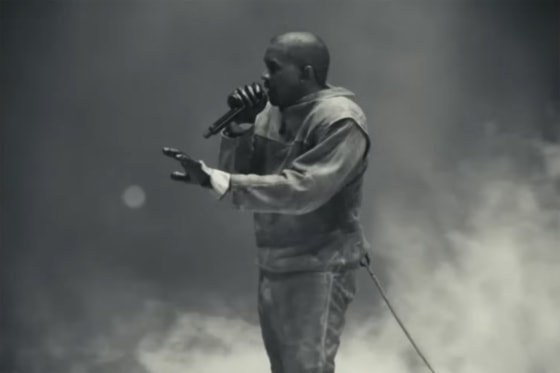
The April 1 opening night was controlled, almost restrained.
Rather than overwhelm, Kanye structured the experience tightly—introducing the system before expanding it.
Appearances were intentional:
The energy was measured. Almost diagnostic.
It felt like testing the boundaries of the environment before pushing it further.
By April 3, the system opened.
The second night scaled the concept outward, stacking appearances that felt less like surprises and more like deliberate placements across time.
Andre Troutman expanded his presence, threading older Kanye textures into the current system.
This wasn’t a guest list.
It was a structure.
Past. Present. Future—compressed into a single environment.
The music followed the same logic as the visuals.
Drawing from the emotional minimalism of 808s & Heartbreak and the spiritual framework of Donda, the set resisted clean structure.
Songs didn’t resolve.
They hovered.
Loops extended beyond comfort.
Vocals felt distant.
Choirs emerged like signals cutting through interference.
At times, the experience felt less like listening to music and more like receiving fragments from within a closed system.
Moments like this are not accidental.
They are constructed.
Together, they move the output away from staging and toward something more precise:
Systems design.
Sound. Space. Symbolism—operating as one.
Kanye West is no longer operating within the logic of live performance.
He is redesigning it.
By removing traditional cues—crowd interaction, predictable structure, emotional signaling—he forces the audience into a different role. Not participants. Observers.
Like Artemis, this is not about reaching the stage.
It is about redefining what the stage becomes once you arrive.
This was not a perfect concert. It was not meant to be.
It was controlled. Expansive. At times disorienting.
But it achieved something more difficult than execution:
It shifted the frame.
You can call it a concert if you want.
But that would undersell what actually happened.
This was Kanye West’s Artemis moment.


.png)
Stay informed with the latest African media trends, job opportunities, and development news. Connecting Africa with global media and development partners.


.avif)
)%20(4).jpg)
)%20(2).jpg)
.png)
.png)
.webp)