.png)


For most of the past decade, South Africa's electricity crisis was the most visible structural constraint on the continent's largest economy. Rolling blackouts, described locally as load-shedding, became a symbol of state capacity failure and a material drag on investment and growth. The return of the Kusile Power Station to full output at approximately 4,800 MW, combined with a rapid expansion of independent renewable generation, has produced a turnaround that the government is now working to consolidate.
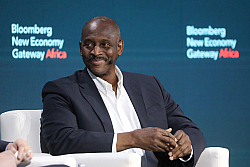
Minister of Electricity and Energy Kgosientsho Ramokgopa, confirmed as a speaker at African Energy Week 2026 in Cape Town in October, is expected to outline the next phase of that consolidation. His framing of the current challenge is instructive. The problem, he has argued, is no longer primarily one of generation. More than 130 GW of generation projects are at various stages of development but have not secured firm offtake agreements. The bottleneck is the grid. Without transmission capacity to move power from where it is generated to where it is consumed, additional generation sits stranded.
The Transmission Development Plan sets out the response: 14,000 kilometres of new power lines and 105 substations by 2030, at an estimated cost of R400 billion, to unlock an additional 22.5 GW of capacity. Neither Eskom nor the national fiscus can fund this alone. The solution the government has chosen is a structural break with decades of state ownership in the electricity sector: the Independent Transmission Projects program, which opened grid infrastructure to private investment for the first time.
In December 2025, Ramokgopa named seven prequalified bidders for the first phase of the ITP program. All seven are international-led consortia. The first phase covers 1,164 kilometres of high-voltage lines across seven corridors, with a combined estimated value of approximately one billion dollars. A request for proposals is expected in the second half of 2026. If the process proceeds as planned, South Africa will have committed to the largest privatisation of critical infrastructure in its post-apartheid history, by value, in the energy sector.
The political economy of that decision is not straightforward. Eskom has historically been both a technical operator and a site of political patronage, employment, and procurement power. Opening transmission to private capital reduces the scope of the utility's future role and introduces performance benchmarks and returns requirements that differ fundamentally from those governing public infrastructure. Labour unions with organised membership in Eskom have historically opposed privatisation of any element of the electricity supply chain. The speed with which the ITP program has moved, from concept to prequalification in under two years, suggests that the government has calculated that the fiscal imperative outweighs the political cost.
The demand signal from the market supports the approach. In the most recent Renewable Energy Independent Power Producer Procurement Program round, 10.2 GW of bids were submitted against the 5 GW on offer. In the 2025 to 2026 financial year, eight new independent power projects came online delivering 800 MW, with another 1,610 MW under construction. Private capital is not waiting to be invited. It is already entering the generation side of the market at scale, and the ITP program represents the extension of that logic to transmission.
What this process means for the broader African context is significant. South Africa's electricity market is the continent's most developed, and the policy frameworks it uses are studied and adapted by other governments across sub-Saharan Africa. If private transmission investment works at scale in South Africa, it provides a proof-of-concept for similar arrangements in other African markets where state-owned utilities are structurally underfunded and grid expansion is a binding constraint on economic growth. If it produces cost overruns, quality failures, or access inequities, it will set back private transmission investment arguments across the continent for a generation.
The Integrated Resource Plan 2025, which Ramokgopa is also expected to address at AEW, provides the generation capacity blueprint. The wholesale electricity market reform, which is intended to move South Africa beyond single-buyer Eskom domination, will determine how generators, distributors, and consumers relate to each other commercially. Together, these three elements, the transmission build, the generation plan, and the market structure, form the full architecture of South Africa's power sector for the next decade. How well that architecture holds under the political and commercial pressures of implementation is the question that October's energy week gathering will begin to answer.


.png)
Stay informed with the latest African media trends, job opportunities, and development news. Connecting Africa with global media and development partners.