
.png)


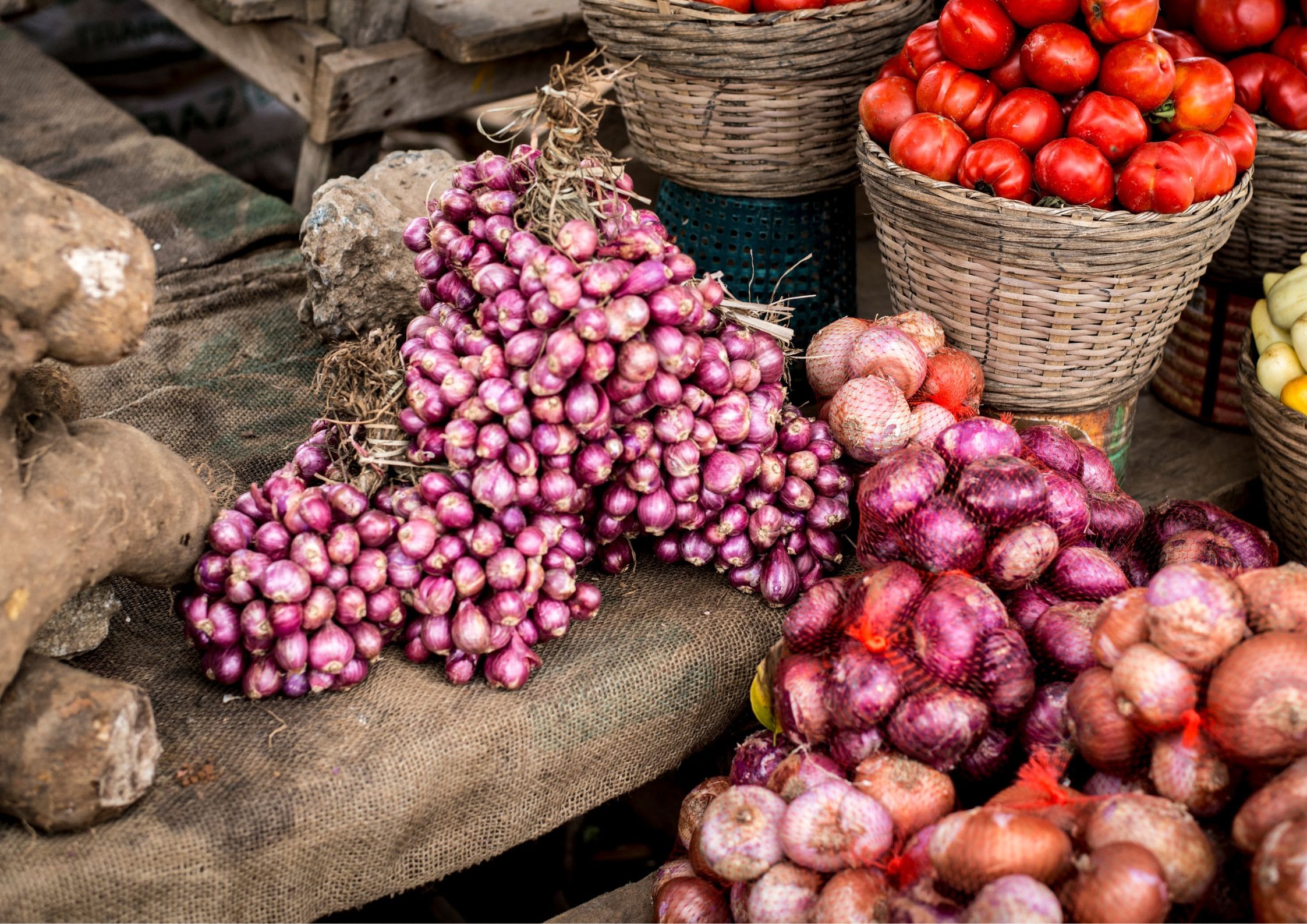
From the dusty plains of Galmi in southern Niger to the crowded markets of Accra, the story of West Africa’s onion trade is one of distance, resilience, and silent economic integration. In Galmi, where the Sahel’s dry winds meet a hard, red soil, farmers have perfected the cultivation of the Violet de Galmi — a purple onion prized across the region for its pungent aroma and remarkable shelf life. The crop is vital to rural Niger’s survival, forming the backbone of one of the country’s largest non-mineral exports. During the dry season, when the Harmattan sweeps across the fields, families dig up onions by hand, leaving them to dry in the open air before sorting and packing them in woven sacks stamped Produit du Niger. For many communities, onions are not just an agricultural product but a guarantee of cash income in a landlocked nation that depends heavily on exports to its coastal neighbours.
Once harvested, the onions begin their long journey south. Convoys of wooden trucks loaded with 20 to 30 tonnes each leave Galmi and Keita, travelling through Maradi and Dosso before reaching the Gaya border post. Gaya, on the Niger River, connects directly to Malanville in Benin — the busiest agricultural crossing between the Sahel and the coast. Every peak season, hundreds of trucks queue for clearance, their tarpaulin-covered loads stretching across the horizon. Malanville has grown into a vast open-air depot where Beninese and Nigerien traders meet, exchange currency, and negotiate prices in the heat. From here, some of the produce feeds Benin’s domestic markets, but most is bound for the south. The road forks at this point: one route continues along the Beninese highway through Kandi, Parakou, and Bohicon to Cotonou, while another heads westward, avoiding the port city altogether, passing through Togo and toward Ghana. Drivers endure potholes, police checkpoints, and long nights on the roadside. Spoilage is common, but profits remain strong enough to sustain the flow year after year.
As the trucks descend through Benin and Togo, they form what traders and drivers call La Route de l’Oignon — the Onion Highway. The route is a lifeline for regional commerce. In Cotonou’s Dantokpa Market, Niger’s onions are mixed with local harvests and priced according to supply and demand, effectively setting the benchmark for the region. From there, lorries roll westward, stopping briefly in Lomé’s Assigamé Market before entering Ghana through the Aflao border. The journey can take up to ten days, spanning over 1,200 kilometres across three borders. It is one of the longest-running and most reliable informal trade networks in West Africa, maintained by trust, habit, and the shared understanding that food must keep moving regardless of politics or infrastructure.
In Ghana, the trucks find their destination at Adjen Kotoku Market, which has replaced the old Agbogbloshie market as the country’s main onion hub. Here, wholesalers, porters, and market queens unload, rebag, and distribute the onions to towns and cities across the country — from Kumasi to Tamale and Takoradi. According to Ghana’s Ministry of Trade and ECOWAS data, more than 70 percent of all onions consumed in Ghana come from Niger. The depth of this dependence became clear in 2023 when the coup in Niger and subsequent border closures disrupted trade through Benin. Within two weeks, Accra’s onion prices doubled, and stocks dwindled as trucks were stranded at Malanville. The incident exposed just how critical the Niger connection is to Ghana’s food security.
In recent years, a quieter transformation has begun to take shape. Instead of operating solely through Ghana’s central markets, Nigerien traders have started opening small retail outlets in Accra’s suburbs. In Dzorwulu, Fadama, North Kaneshie, Oyarifa, and around Adjen Kotoku itself, “onion-only” shops have appeared — compact depots run by Nigerien men who import directly from their home networks. These traders bypass traditional middlemen and market associations, selling directly to restaurants, food vendors, and households. Their prices are often 10 to 15 percent lower than those found in the major markets, thanks to direct sourcing and family-based credit systems that cut costs. In doing so, they have created a self-sufficient trade loop that begins in Galmi and ends at the doorstep of Ghanaian consumers.
The emergence of these Nigerien-run depots is quietly redrawing Ghana’s onion economy. Market queens who once controlled bulk supply and warehouse space at Adjen Kotoku are losing influence as more buyers shift to community-based suppliers. Consumers benefit from stable prices and a steady supply, while local assemblies lose potential tolls and market fees from these informal shops. For the Nigerien traders, the shift represents upward mobility — a move from bulk trading to micro-retail with higher profit margins and greater market reach. Culturally, it has introduced a new dynamic into Ghana’s trading ecosystem. Many of these traders are Hausa-speaking Muslims who have built small but tightly knit networks in Accra’s urban communities, contributing to a subtle but growing Sahelian presence in the capital’s food economy.
The movement of goods along this corridor is not one-way. Trucks that deliver onions south often return to Niger carrying Ghanaian salt from Ada and Sege, creating a reverse trade that mirrors the same supply logic: onions flow to the coast, salt flows to the desert. Ghana now supplies roughly 40 percent of Niger’s salt imports, completing a circular economy driven by necessity and proximity. The exchange is practical, efficient, and deeply regional — a microcosm of how African markets function when left to their own devices.
Beyond the economic figures and logistics, the Onion Highway tells a deeper story about regional integration in West Africa. Long before formal trade agreements like ECOWAS or the AfCFTA, farmers, transporters, and small traders had already built networks of trust that crossed borders and currencies. These onion and salt traders exemplify what economists call “integration from below” — cooperation born out of everyday survival and enterprise rather than policy. As Nigerien onion depots continue to multiply across Accra, they embody a quiet but powerful transformation: the expansion of Sahelian commerce into the heart of coastal Africa, carried not by corporations or governments, but by ordinary traders who have turned a simple bulb into a bridge between nations.


.png)
Stay informed with the latest African media trends, job opportunities, and development news. Connecting Africa with global media and development partners.
.jpg)


%20(1).avif)
)%20(1).jpg)
.avif)


.avif)
.webp)