.png)


For decades, the debate about reparations occupied a familiar corner of international politics.
It appeared at academic conferences.
It surfaced during anniversaries.
It emerged in speeches by activists, historians and descendants of enslaved peoples.
Then it disappeared again.
For much of modern history, reparations remained a moral argument without a political vehicle.
That may be changing.
Last week in Accra, Ghana hosted a High-Level Consultative Conference on the next steps following the landmark United Nations resolution recognising the trafficking of enslaved Africans and racialised chattel slavery as one of humanity's gravest crimes.
The conference was significant not simply because of who attended.
Presidents attended.
Prime ministers attended.
Diplomats attended.
Scholars attended.
Activists attended.
What made the gathering significant was the question it forced into the centre of global politics:
Who owes Africa what?
The answer, depending on who was speaking, varied dramatically.
And therein lies the real story.
The transatlantic slave trade was not a historical accident.
Between the fifteenth and nineteenth centuries, millions of Africans were captured, transported across oceans and reduced to property.
The consequences were profound.
Entire societies were disrupted.
Communities were fractured.
Economic systems were distorted.
Human beings became commodities.
At the same time, enormous wealth was accumulated elsewhere.
Ports expanded.
Banks grew.
Insurance markets flourished.
Industrial economies developed.
Empires strengthened.
The debate over reparations begins with this reality.
Supporters argue that while the individuals responsible are long dead, many of the institutions that benefited from the trade survived and prospered.
The wealth generated by slavery did not simply disappear.
It became embedded in economic systems, institutions and national development trajectories.
For many African and Caribbean leaders, this is why reparations remain a contemporary issue rather than merely a historical one.
As Ghana's President, John Dramani Mahama, observed during the conference:
"History does not ask us to inherit guilt, but it asks us to inherit responsibility."
That statement may ultimately become one of the defining ideas of the modern reparations movement.
The debate is no longer centred on personal guilt.
It is increasingly centred on institutional responsibility.
The conference did not end with symbolism alone.
Delegates endorsed a framework that called for formal apologies, debt relief, restitution of cultural artefacts, educational reforms and the establishment of a global reparations fund.
Whether those proposals materialise is another matter entirely.
The political and legal obstacles remain immense.
The United Kingdom continues to reject reparations claims.
The United States has historically opposed the concept of legal liability for historical injustices that predate modern international law.
Many European governments remain cautious about opening debates that could carry significant financial implications.
Yet something important has changed.
For the first time, a growing coalition of African and Caribbean states is attempting to transform moral arguments into policy demands.
The conversation is moving from remembrance to implementation.
It was against this backdrop that French President Emmanuel Macron offered a message that revealed the complexity of the debate.
Macron acknowledged the horrors of slavery and recognised the dehumanisation of millions of Africans.
However, he cautioned against reducing reparations to a financial transaction.
Justice, he suggested, cannot simply be measured in monetary terms.
His intervention highlighted an increasingly important question.
What exactly constitutes reparatory justice?
Is it money?
Is it debt cancellation?
Is it cultural restitution?
Is it educational investment?
Is it institutional reform?
Or is it something larger than all of these?
Macron's critics viewed the intervention as another attempt by Europe to redefine the terms of accountability.
His supporters viewed it as recognition that historical trauma cannot be resolved through compensation alone.
The disagreement illustrates how far apart different sides remain on the practical meaning of reparations.
If Macron represented caution, veteran Ghanaian journalist Kwesi Pratt represented impatience.
Pratt's criticism was direct.
He described Macron's participation as "totally unacceptable."
For Pratt, reparations are not an act of generosity.
They are not development aid.
They are not charity.
They are justice.
His argument rests on a straightforward premise.
The slave trade was organised.
Colonial systems were organised.
Institutions profited.
Governments profited.
Banks profited.
Companies profited.
Churches profited.
Therefore responsibility should not remain abstract.
It should be identifiable.
Specific.
Concrete.
Pratt's position reflects a growing sentiment among reparations advocates who believe expressions of regret have outlived their usefulness.
In their view, acknowledgment without accountability risks becoming another form of delay.
Yet perhaps the most consequential intervention came from someone who shifted attention away from the past entirely.
Nobel Laureate Wole Soyinka warned African leaders against becoming trapped in what he described as performances, discussions and rhetoric.
His challenge was uncomfortable because it implicated everyone.
While delegates debated the crimes of centuries ago, Soyinka pointed toward crimes occurring today.
Human trafficking.
Kidnapped children.
Modern slave markets.
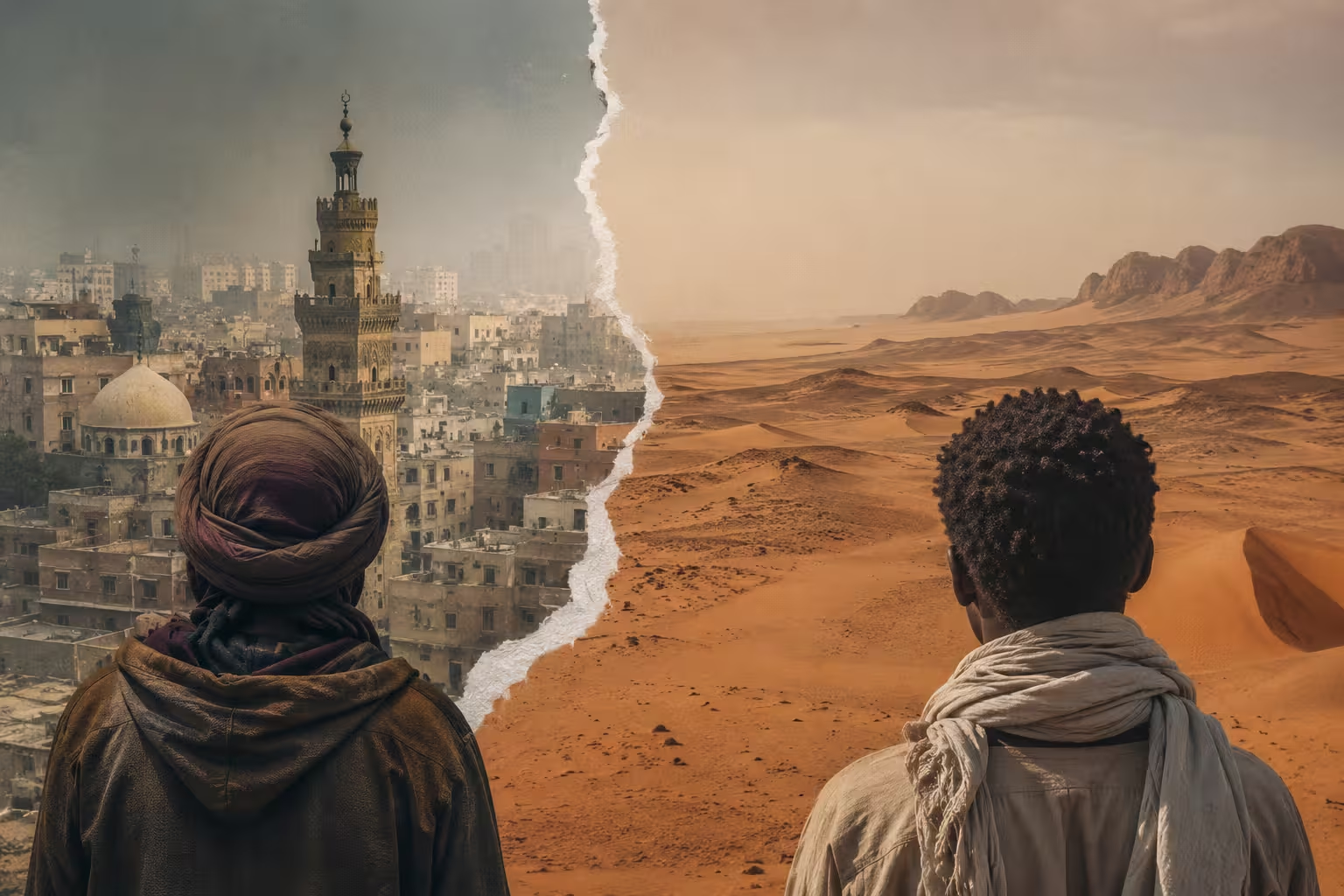
Young Africans drowning in the Mediterranean while attempting to reach Europe.
His message was not that reparations should be abandoned.
Far from it.
His message was that justice must also address contemporary realities.
A continent cannot demand accountability from the world while ignoring forms of exploitation occurring within its own borders.
In many ways, Soyinka's intervention may prove the most enduring.
Because it expanded the debate.
The question was no longer merely what Europe owes Africa.
The question became what Africans owe one another.
This may be the most important lesson from Accra.
The reparations debate is evolving beyond a dispute about money.
It is becoming a debate about responsibility.
Former colonial powers have responsibilities.
Institutions that benefited from slavery have responsibilities.
But African governments also have responsibilities.
African elites have responsibilities.
African societies have responsibilities.
If reparations arrived tomorrow, what would success look like?
Would it be measured in financial transfers?
In restored artefacts?
In educational investments?
In infrastructure?
In industrialisation?
In stronger institutions?
In opportunities that convince young Africans not to risk their lives crossing deserts and seas?
These questions remain unresolved.
Yet they are becoming increasingly difficult to avoid.
The significance of Accra lies not in the resolutions adopted or the speeches delivered.
It lies in the fact that the conversation has entered a new phase.
The world no longer argues seriously about whether slavery happened.
The world no longer argues seriously about whether it was a crime.
The emerging argument concerns responsibility.
Who bears it.
How much of it exists.
What form it should take.
And whether justice can ever fully repair historical wounds that continue to shape the present.
The answers will not emerge quickly.
Nor will they emerge unanimously.
But one thing is increasingly clear.
The debate has moved beyond history.
It now concerns the future.
And that future begins with a question that echoed through the halls of Accra:
Who owes Africa what?


.png)
Stay informed with the latest African media trends, job opportunities, and development news. Connecting Africa with global media and development partners.

.png)
.avif)
.jpeg)