
.png)


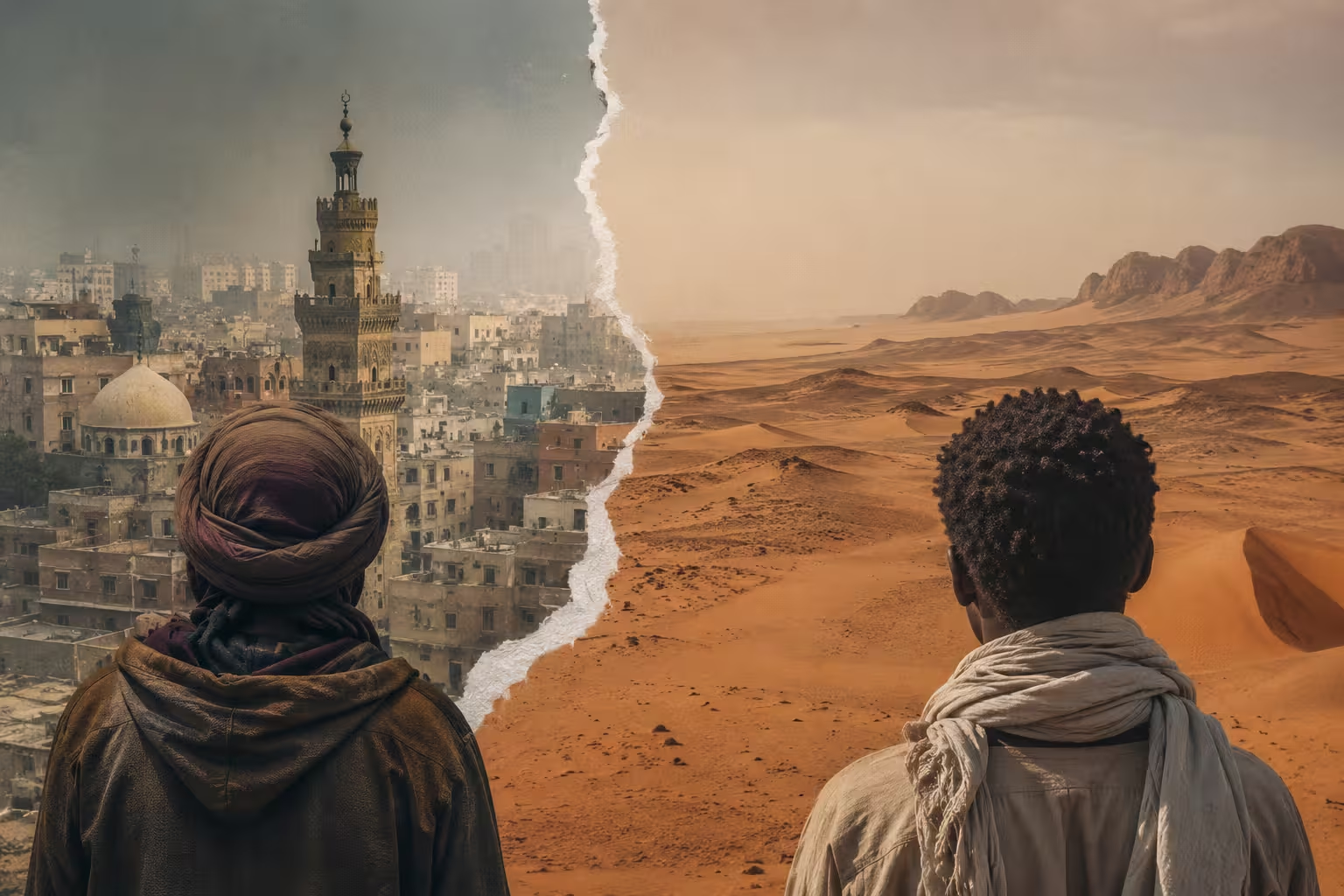
A deadly airport attack in Niger and the military government's allegations of foreign-backed mercenaries have intensified debate over a larger shift: Africa is becoming the arena where global powers compete for military influence, strategic alliances and geopolitical control.
For decades, Africa was viewed primarily as a battleground for resources.
Oil.
Gold.
Diamonds.
Rare earth minerals.
Today, another competition is unfolding.
It is not being fought over who controls the continent's mines, but over who shapes its security, influences its governments and becomes the military partner of choice for African states confronting terrorism, coups and instability.
The deadly attack on Niger's main international airport has become the latest flashpoint in that contest.
The assault itself lasted only hours.
Its geopolitical consequences could last years.
## An Airport Attack That Shook the Sahel
Armed militants launched a coordinated assault on Diori Hamani International Airport and the adjacent military facilities in Niger's capital, Niamey.
According to Nigerien authorities, eleven members of the security forces and two civilians were killed during the attack. Authorities also reported that twenty-two attackers were killed during the military response. The al-Qaeda-linked militant group Jama'at Nusrat al-Islam wal-Muslimin (JNIM) later claimed responsibility for the assault.
The attack was significant for more than its casualty figures.
Diori Hamani International Airport is not simply Niger's busiest civilian airport.
It also serves as an important military hub, housing aircraft, drones and facilities used by Niger's armed forces and by the Alliance of Sahel States, the regional security bloc created by Niger, Mali and Burkina Faso.
The choice of target sent a clear message.
Armed groups are increasingly capable of striking not only remote military outposts but strategic infrastructure in national capitals.
Soon after the attack, Niger's Defence Ministry alleged that France-backed mercenaries had participated in the assault.
The allegation intensified already strained relations between Niger and France.
However, Niger's government has not publicly presented evidence to substantiate the claim, and France has rejected similar accusations made previously by the military-led authorities. At the same time, JNIM publicly claimed responsibility for carrying out the attack.
Whether or not the allegation is ultimately substantiated, it reflects a broader reality.
Across the Sahel, security crises are increasingly interpreted through the lens of international geopolitical rivalry.
To understand today's tensions, it is necessary to revisit the last decade.
For years, France was the dominant foreign military actor across much of the Sahel.
Following the rise of jihadist groups after the collapse of Libya in 2011, France launched Operation Serval in Mali before expanding into the broader regional counterterrorism mission known as Operation Barkhane.
Thousands of French soldiers were deployed across Mali, Niger, Burkina Faso and neighbouring countries.
Initially, many governments welcomed the intervention.
But as violence spread rather than receded, public frustration grew.
Military coups in Mali, Burkina Faso and Niger accelerated demands for France's withdrawal.
By 2024, French troops had left all three countries.
For many citizens, France had come to symbolise a security strategy that had failed to end extremist violence.
As French influence declined, Russia expanded its presence.
Military cooperation agreements increased.
Russian instructors and personnel became more visible.
The Wagner Group, and later Russia's Africa Corps, emerged as important security partners for several military governments in the region.
The shift reflected more than changing military contracts.
It represented a strategic reorientation.
The governments of Mali, Burkina Faso and Niger argued that they wanted partnerships free from what they described as Western political conditions.
Yet despite this realignment, security has continued to deteriorate in many areas.
Militant organisations linked to al-Qaeda and the Islamic State remain capable of launching increasingly sophisticated attacks, while analysts warn that the overall security picture across the Sahel has become more complex rather than more stable.
Today's competition in the Sahel differs from the ideological Cold War of the twentieth century.
Then, the rivalry was between capitalism and communism.
Today's contest is about influence.
Who trains African armies?
Who supplies weapons?
Who provides intelligence?
Who builds military infrastructure?
Who becomes the preferred diplomatic partner?
The answers increasingly shape political decisions across the continent.
Military partnerships are no longer simply defence arrangements.
They influence foreign policy, trade, development assistance and regional alliances.
While governments reshape international partnerships, extremist organisations have continued to adapt.
Groups affiliated with al-Qaeda and the Islamic State now operate across a vast belt stretching from Mali through Burkina Faso and Niger toward coastal West Africa.
Recent attacks demonstrate a worrying evolution.
Rather than focusing exclusively on isolated military positions, militants are increasingly targeting airports, major towns and strategic infrastructure.
Analysts warn that competition between rival jihadist organisations has also intensified, increasing the likelihood of more frequent and more ambitious attacks.
Many Africans living far from Niger may view these developments as distant.
They are not.
The Sahel sits at the heart of West Africa.
Instability there affects migration, cross-border trade, investment, food security and regional cooperation.
As violence spreads southward toward coastal states, countries such as Benin and Togo have experienced increasing militant activity, while Ghana, Côte d'Ivoire and other neighbours continue strengthening border security.
The consequences therefore extend well beyond Niger.
Africa is entering a new geopolitical era.
The continent is no longer simply responding to global competition.
It is increasingly shaping it.
Global powers recognise Africa's growing strategic importance—not only because of its critical minerals and young population, but because of its geographic position, expanding markets and security partnerships.
That creates opportunities.
It also creates risks.
External partnerships can strengthen national security, but they can also deepen geopolitical rivalries if African states become proxies in broader international competition.
The airport attack in Niamey will eventually become another entry in the long history of the Sahel's security crisis.
The larger question will remain.
Can African governments build effective security partnerships without becoming arenas for competing foreign interests?
The answer will influence not only the future of Niger, but the political and security trajectory of the entire continent.
The new contest for influence in Africa has already begun.
The question is no longer whether it exists.
It is whether African nations can shape its outcome on their own terms.


.png)
Stay informed with the latest African media trends, job opportunities, and development news. Connecting Africa with global media and development partners.
%20(1).avif)

%20(1).avif)
.avif)
.jpeg)
.webp)
.jpeg)