.png)


A systematic look at four simultaneous U.S. policy moves and what they add up to.
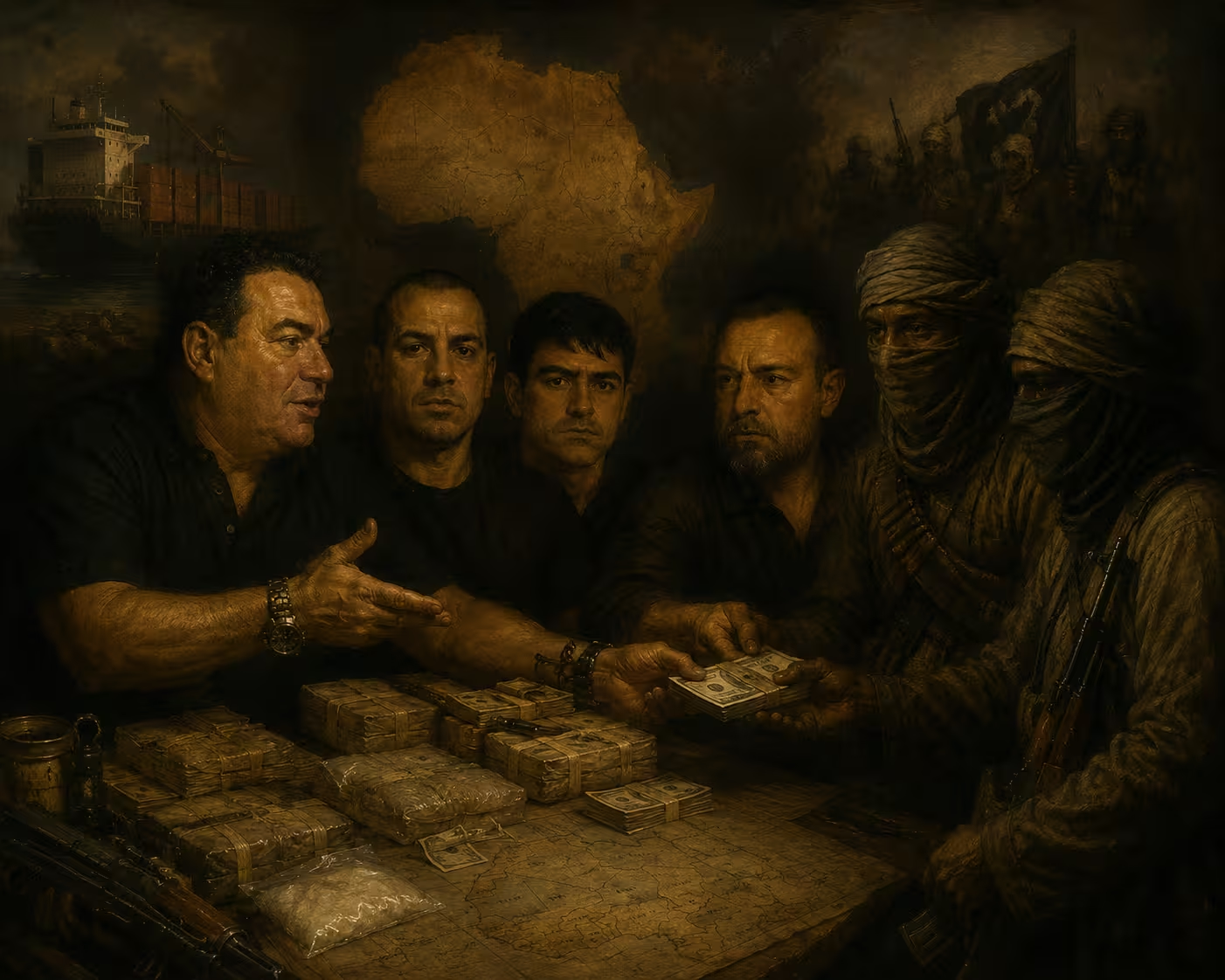
In January 2025, when the Trump administration signed its first executive orders, the consequences for Africa were immediate but scattered. A funding freeze here. A tariff announcement there. A visa memo that arrived without warning. Taken one at a time, each could be explained as domestic American politics — protectionism, immigration enforcement, budget discipline. Taken together, they form a different picture: a coordinated withdrawal from a continent that the United States had, for 25 years, treated as a strategic development partner.
This is the story of four punches, landed in sequence, on the same target.
The African Growth and Opportunity Act was never a perfect instrument. Since 2000, Africa's share of total U.S. imports actually declined from 2.00 percent to 0.97 percent Africachinareporting over the programme's lifetime — a reminder that preferential access alone does not build trade. But for specific countries and specific sectors, AGOA was life changing. In 2022, the U.S. market accounted for almost 70% of Kenya's textile exports, which were exported under AGOA's clothing and textile preferences. Acme-ug Lesotho built an entire garment manufacturing sector on AGOA's framework, employing close to 36,000 workers, the majority of them women.
In April 2025, Trump's "Liberation Day" tariffs arrived. Nigeria and South Africa were among those on Trump's "reciprocal" tariffs list — countries the president said "treat us badly." South Africa faced a 31% tariff; Nigeria, 14%. Native Media These tariffs did not formally abolish AGOA. They simply made it irrelevant. AGOA only waives the standard tariff rate the U.S. applies to all WTO members — which averaged just 3.3%. The reciprocal surcharges of 10% to 30% applied on top of whatever AGOA offered, rendering its duty free promise meaningless. Themediaonline
AGOA technically expired in September 2025. Trump signed a one year extension in February 2026 — but analysts described resuscitating AGOA as largely meaningless, since its benefits were overridden by other measures. Statista The numbers bear this out. AGOA exports dropped 32% in the year ending November 2025 compared to 2024. South African auto exports, which had been a major AGOA beneficiary, plunged almost 75% — from 25,544 vehicles to 6,530. TransPerfect Media
A report from the Center for Strategic and International Studies estimated that close to 300,000 direct jobs and up to 1 million indirect jobs would disappear once the deal effectively expired. The Liberalist Those are not statistics. They are factory workers in Maseru, garment stitchers in Nairobi, logistics operators in Lagos — people who built livelihoods on a trade framework that no longer functions as advertised.
Meanwhile, China moved in the opposite direction. China's new zero tariff policy for 53 African countries, beginning 1 May 2026, covers all tariff lines and extends previous preferences to middle income exporters such as Kenya, South Africa, Nigeria, Egypt, and Morocco — countries that previously faced Chinese tariffs of up to 25% on processed goods. Themediaonline The contrast was not lost on African policymakers.
On January 24, 2025, the Trump administration issued an executive order freezing all foreign aid programs. For Africa's health systems — particularly in southern and eastern Africa, which have been in a decades long battle against HIV — the consequences were immediate and severe.
The U.S. government, through PEPFAR, contributed an estimated $301.6 million for HIV prevention across 15 countries in the region, making it the largest single funder — close to 45% of total HIV prevention funding. Several high burden countries were almost entirely dependent on PEPFAR: Malawi at 88.5%, Zimbabwe at 82.7%, and Mozambique at 81.8%. JURIST
The practical consequences landed fast. In South Africa alone, over 8,000 skilled healthcare workers lost their jobs, multiple clinics closed, and essential services such as HIV testing, treatment, and prevention were significantly reduced. International Press Institute In Kenya, approximately 41,000 doctors, nurses, technical and management staff and community workers had been supported by U.S. government funding. JURIST
In Zimbabwe, the collapse was near total. Zimbabwe, where USAID funded about 80 percent of the HIV response, was so badly hit that even condom supplies ran short. 234Digest A grant worth $53 million, intended to reduce HIV infections among adolescent girls and young women and scheduled to run until September 2026, was terminated abruptly. MSF's country representative in Zimbabwe said the cuts had produced "a total collapse in community based and prevention programming, especially for key populations who are now entirely left behind." ShockNG
The science tells the future in blunt terms. A peer reviewed modelling study projected up to 74,000 excess HIV deaths across seven sub Saharan African countries by 2030 Deadline as a direct consequence of the funding freeze. The broader global estimate was starker: PEPFAR funding losses across all low income and middle income countries could result in up to 10.75 million additional new HIV infections and up to 2.93 million HIV related deaths between 2025 and 2030. International Press Institute
A lenacapavir trial in South Africa — a drug that proved 100% effective in preventing HIV infection, requiring only two injections every six months — had been moving toward generic production with USAID support. That pipeline is now completely gone, 234Digest according to the Desmond Tutu Health Foundation's chief scientific officer. The drug will not reach the people who need it.
In May 2025, the U.S. House of Representatives passed the "One Big Beautiful Bill" — a comprehensive legislative package that includes a provision imposing a tax on remittances sent abroad by non citizens. African Exponent The rate has been contested in drafting — proposals ranged from 1% to 5% — but even at the lowest end, the arithmetic for African families is damning.
African countries received over $90 billion in remittances in 2024. African Exponent These are not diplomatic transfers or development grants. They are a parent paying school fees. A sibling covering a hospital bill. A daughter sending rent money home from a university in Texas. Remittances, unlike foreign aid, go directly to households — bypassing the bureaucratic and governance failures that limit aid's effectiveness.
A study by the Center for Global Development estimates that the tax could lead to a 1.6% drop in remittance volumes. The impact would be most severe in Nigeria, which could lose $168.2 million. Egypt would see a drop of $54.15 million, Kenya $38.11 million, and Ghana $33.63 million. International Trade Administration
That is the optimistic scenario. The 1% tax would add to existing fees already charged by transfer providers. In sub Saharan Africa, remittance costs are already the highest globally — sending $200 cost an average of 7.9% in the fourth quarter of 2023. International Trade Administration Higher costs will push senders toward informal channels, which carry greater security risks and remove transactions from financial systems that governments can track and tax.
For smaller economies, the exposure is existential. In 2023, remittances made up over 20% of GDP in both Lesotho and the Comoros. International Trade Administration For these countries, a remittance tax is not an inconvenience. It is a structural shock.
A Nigerian American student captured the human reality simply: "In the U.S., it might feel like, 'Oh, that's nothing.' But in Nigeria, it's everything because every little money counts." Springer
The final punch is the one African professionals, students, and families feel most personally.
In June 2025, President Trump signed an executive order imposing a travel ban on 12 countries — including Chad, Equatorial Guinea, Eritrea, Republic of Congo, Somalia, and Sudan — while severely restricting immigration from seven additional countries including Sierra Leone and Togo. Columbia Business School By December, the ban had expanded dramatically. With the new ban in place, roughly 1 in 5 people seeking to immigrate to the United States legally are now barred from doing so. CGAA
The country most heavily impacted is Nigeria. Over the last decade, Nigerians received an average of 128,000 immigrant and nonimmigrant visas annually. Nearly all of these visas are now restricted — blocking legal immigration from the most populous country in Africa. CGAA
The stated rationale is visa overstay rates. The reality, as analysts have documented, is that the thresholds were set specifically to capture African and Muslim majority countries while exempting allies with comparable or worse data. Countries like Belarus and Russia exceed the administration's overstay rate thresholds yet are not targeted, for obvious geopolitical reasons. Broadcastmediaafrica
On top of the travel bans, the Trump administration introduced visa bond requirements — a cash deposit of up to $15,000 that applicants must pay before receiving a visa. The programme began with Malawi and Zambia in August 2025 and has since expanded to cover more than half of African states. Fact Check Africa Critics argue that the high bonds discriminate against low income travellers. Eighty20 They are correct. A $15,000 bond is not a burden for a wealthy Nigerian businessman. It is an absolute barrier for a Malawian student, a Zambian nurse, or a Senegalese entrepreneur seeking a trade conference visa.
Mali and Burkina Faso responded by imposing full visa bans on U.S. citizens in retaliation. Acme-ug The diplomatic rupture is now complete in parts of West Africa — countries that had partnered with the U.S. on security, health, and trade now treat American citizens the way Washington treats theirs.
Each of these four moves has its own rationale within American domestic politics. AGOA was framed as unfair trade. USAID was framed as wasteful spending. The remittance tax was framed as immigration enforcement. The visa bans were framed as national security. Individually, each can be debated on its merits.
Together, they are something else. They represent the simultaneous withdrawal of four distinct forms of American engagement with Africa: trade access, development aid, financial flows, and human mobility. There is no precedent for all four being targeted at once.
African policymakers must look elsewhere for new trade opportunities. China's new zero tariff policy offers some relief from U.S. protectionism. Themediaonline The African Continental Free Trade Area — long a framework in search of implementation — now has the pressure it needs to move faster. Countries like Uganda have resolved to build more resilient and self sustaining domestic economies. Zimbabwe offered to unilaterally eliminate tariffs on U.S. imports. South Africa pledged to deepen intra African trade. Acme-ug
These are the responses of countries that did not choose this moment but must navigate it. The question for African leaders is whether the withdrawal of American engagement becomes a clarifying crisis — one that finally accelerates the regional integration, domestic revenue mobilisation, and South to South partnerships that four decades of aid dependency deferred.
America didn't just walk away from Africa. It did it four different ways, at the same time. The continent's response will define the next decade of its economic and political development.
Sources: ISS Africa, TRALAC, UNAIDS, The Conversation, CSIS, Center for Global Development, NBC News, Al Jazeera, American Immigration Council, MSF, ScienceDirect, The Africa Report, TechCabal.


.png)
Stay informed with the latest African media trends, job opportunities, and development news. Connecting Africa with global media and development partners.