.png)


The story began not in parliament, nor in a government office, but behind prison walls. A convicted trafficker had nothing left to lose—and what he told investigators would shake Morocco's political establishment to its core.
For years, the whispers were familiar.
Across North Africa, stories circulated about drug routes cutting through the Sahara, fortunes built in secrecy, and powerful people who seemed untouchable. They were the kind of allegations that often surfaced in cafés, on social media and in political debates, but rarely found their way into courtrooms.
Then a prisoner began to talk.
Known across Moroccan media as the "Escobar of the Sahara," El Hadj Ahmed Ben Brahim was already serving a prison sentence when he accused some of Morocco's most influential figures of helping him build—and later seize control of—an international criminal empire.
What followed was one of the country's largest criminal investigations in decades.
By the time the trial reached its conclusion in June 2026, it had become much more than a narcotics case. It had evolved into a test of whether political influence could shield the powerful from the law.
Inside a packed courtroom in Casablanca, judges delivered a decision that many had once considered unlikely.
Former Oriental Region council president **Abdenbi Bioui** was sentenced to **12 years in prison**.
Former Member of Parliament and former Wydad Athletic Club president **Saïd Naciri** received **10 years**.
Dozens of other defendants—including businessmen and public figures—also received prison terms after the court convicted 29 people in connection with the sprawling case.
The sentences were accompanied by asset confiscations, substantial financial penalties and compensation orders, underscoring the scale of what prosecutors described as a sophisticated criminal enterprise.
As the verdicts were read, the courtroom descended into chaos.
Some defendants protested their innocence. Family members wept openly. Others reportedly collapsed in disbelief as police restored order.
For many Moroccans, it was a moment that few expected to witness: members of the political elite leaving the courtroom not as lawmakers or public officials, but as convicted criminals.
Investigators allege that the network stretched far beyond Morocco's borders.
Rather than operating as a conventional drug syndicate, prosecutors argued that it functioned like a multinational enterprise—using logistics, political influence, financial networks and legitimate businesses to move illicit goods across the region.
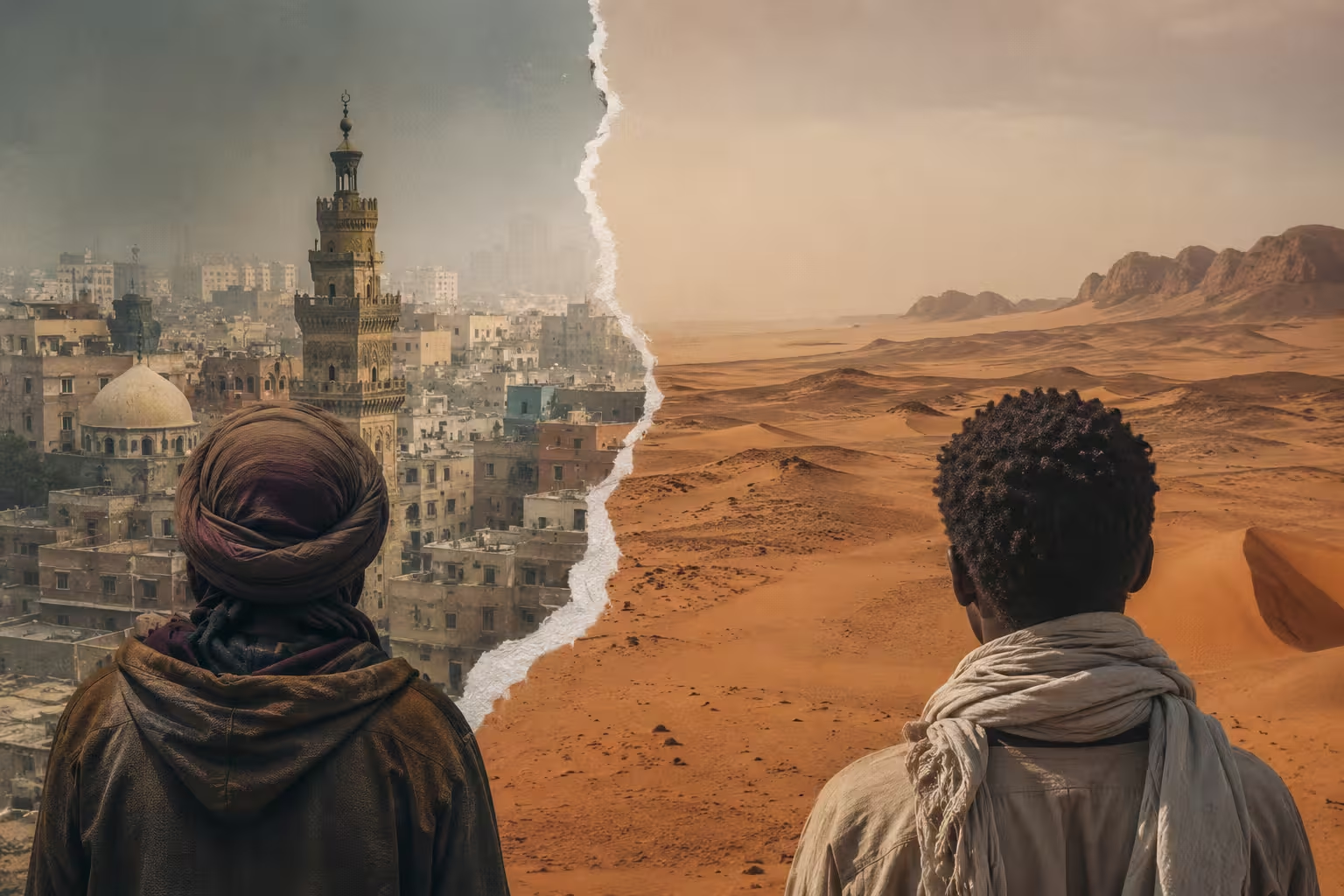
Authorities believe trafficking routes crossed parts of the Sahara into countries including Mauritania, Libya and Egypt before connecting with wider international markets.
The alleged operations involved cannabis resin, money laundering, gold transactions and cross-border financial activity.
While prosecutors have not publicly disclosed every operational detail, the portrait presented during the trial was that of an organization whose greatest asset was not simply its access to narcotics—but its access to influence.
The most striking aspect of the case was not the drugs.
It was the defendants.
Abdenbi Bioui was one of eastern Morocco's most influential politicians, serving as president of the Oriental Regional Council.
Saïd Naciri was a familiar national figure. Beyond parliament, he led Wydad Athletic Club, one of Africa's most successful football institutions, giving him visibility that extended well beyond politics.
Their prominence transformed what might have been another trafficking prosecution into a national reckoning.
For anti-corruption advocates, the case raised uncomfortable questions.
Can organized crime flourish without protection from influential figures?
How deeply can criminal networks penetrate legitimate institutions before they become indistinguishable from them?
And when political power and criminal enterprise begin to overlap, where does governance end and organized crime begin?
According to investigators, the turning point came from the man at the centre of the affair.
Ben Brahim claimed that influential individuals had helped facilitate his operations before later taking control of his assets after his arrest.
His allegations extended beyond narcotics.
He accused powerful figures of appropriating luxury vehicles, villas, businesses and other properties linked to his criminal empire.
Those claims prompted investigators to reopen financial records, examine business relationships and scrutinize years of transactions that allegedly connected politics, commerce and organized crime.
Whether every allegation ultimately withstands further legal scrutiny remains a matter for Morocco's courts. Appeals are expected, and the convicted defendants have maintained their innocence.
Yet the testimony was enough to trigger one of the country's most consequential prosecutions in recent memory.
Morocco occupies one of the world's most strategically important crossroads.
Positioned between sub-Saharan Africa and Europe, the kingdom has long served as a gateway for trade, migration and investment.
That geography also makes it attractive to transnational criminal organizations.
International law enforcement agencies have repeatedly warned that trafficking networks increasingly rely on sophisticated financial structures, shell companies and political relationships rather than brute force alone.
In today's illicit economy, influence can be more valuable than weapons.
The "Escobar of the Sahara" case reflects that evolution.
It is not merely a story about narcotics moving through desert routes. It is a story about how criminal organizations seek legitimacy by embedding themselves within institutions designed to govern society.
The implications extend far beyond Morocco.
Across the continent, governments face growing pressure to strengthen institutions against corruption, illicit financial flows and transnational organized crime.
The question is no longer whether these networks exist.
It is whether African institutions are equipped—and willing—to confront them when investigations point toward politically connected individuals.
Morocco's verdict offers one possible answer.
By sentencing senior political figures alongside businessmen and other associates, the judiciary has signaled that public office does not automatically guarantee immunity.
Whether this marks the beginning of a broader campaign against entrenched criminal networks or remains an exceptional case will depend on what happens next.\The bigger story
The "Escobar of the Sahara" affair is not simply about a drug trafficker.
It is about the hidden architecture of power.
It is about how criminal organizations exploit institutions, how political influence can become a shield for illicit enterprise, and how difficult it is for any democracy to confront corruption when it reaches into its own leadership.
For years, the Sahara has been viewed as a vast expanse separating nations.
This case suggests something different.
For organized crime, it has often been a bridge.
And when that bridge reaches into politics, the consequences are felt far beyond the courtroom.


.png)
Stay informed with the latest African media trends, job opportunities, and development news. Connecting Africa with global media and development partners.
.avif)
.jpeg)

.avif)

.avif)