.png)


There are few ideas that Africans agree on as passionately as the idea of African unity.
Mention a common African passport and many people nod.
Talk about free movement across the continent and most people support it.
Speak about Africa negotiating with the world as a single economic force and it sounds like common sense.
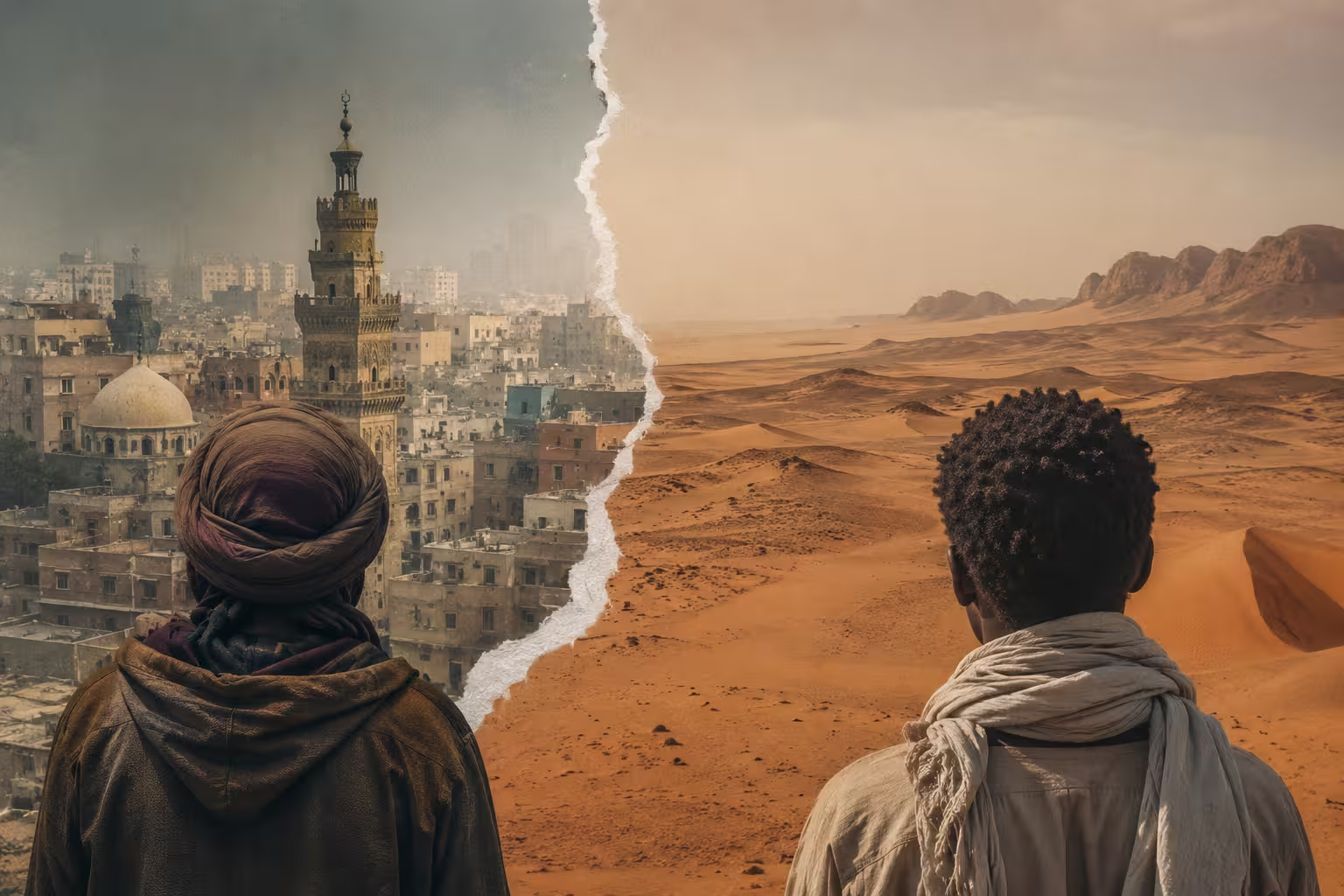
Yet beneath the speeches, the conferences, and the Pan African slogans lies a question that makes many people uncomfortable.
How united do Africans actually want Africa to be?
Because there is a difference between supporting unity in theory and accepting its consequences in practice.
That distinction may explain why one of the continent's oldest political dreams remains unfinished.
In 1963, Ghana's first president, Kwame Nkrumah, arrived in Addis Ababa with a bold proposal.
Many newly independent African countries were still finding their footing. Colonial rule had ended in many places, but economic dependence remained. Foreign powers still held enormous influence over African markets, resources, and political systems.
Nkrumah believed Africa had a narrow window of opportunity.
His argument was simple.
If African countries united politically and economically, they could become one of the most powerful blocs in the world.
If they remained fragmented, they would spend generations negotiating from a position of weakness.
He called for a United States of Africa.
Most African leaders disagreed.
They feared that surrendering authority to a continental government would weaken their newly independent states.
National sovereignty won the argument.
And it has continued winning for more than six decades.
Today, Africa is home to more than 1.5 billion people.
Yet the continent remains divided into 54 countries, dozens of currencies, hundreds of border regulations, and countless administrative barriers.
A business owner in Accra can often find it easier to trade with Europe than with some African countries.
Flights between African capitals can be among the most expensive in the world.
Many Africans still require visas to visit fellow African countries.
Despite decades of discussions about integration, the dream of a truly united Africa remains distant.
The question is why.
Most Africans support cooperation.
The challenge begins when cooperation evolves into integration.
Imagine a continent with a single passport.
Imagine a continent where professionals can live and work anywhere without restrictions.
Imagine a common currency.
Imagine a continental parliament.
Imagine a continental court.
Suddenly the conversation changes.
Would governments be willing to surrender some authority?
Would citizens accept decisions made outside their own countries?
Would stronger economies dominate weaker ones?
Would smaller countries lose influence?
These are not economic questions alone.
They are questions of trust.
Many discussions about African integration focus on colonial borders.
The borders certainly matter.
But perhaps the larger challenge is institutional trust.
People trust what they know.
They trust local institutions more easily than distant ones.
A Ghanaian may support African unity but still prefer Ghanaian control over taxes, elections, laws, and monetary policy.
A Nigerian may support integration while remaining cautious about transferring authority to a continental institution.
A Kenyan may feel the same.
The challenge is not whether Africans believe in Africa.
The challenge is whether Africans trust Africa enough to share power.
Supporters of integration argue that Africa's future depends on scale.
No African country alone can fully match the economic influence of China, the United States, India, or the European Union.
Together, however, Africa possesses enormous advantages.
A youthful population.
Abundant natural resources.
A rapidly growing consumer market.
Strategic geographic position.
A larger integrated market could increase trade, attract investment, strengthen bargaining power, and reduce dependence on external partners.
From this perspective, unity is not merely an ideal.
It is an economic necessity.
Critics of deeper integration argue that every country faces unique realities.
Economic conditions differ.
Political systems differ.
Development priorities differ.
Many believe governments should remain accountable primarily to their own citizens.
For them, sovereignty is not an obstacle to progress.
It is a safeguard against overcentralization and loss of democratic control.
In this view, cooperation should expand without creating a continental superstate.
Perhaps the most remarkable thing about the African unity debate is that it has survived for more than sixty years without a definitive resolution.
The arguments have changed.
The world has changed.
Africa has changed.
Yet the central question remains exactly where Nkrumah left it.
Should Africa become more united?
Or should African nations continue strengthening themselves individually while cooperating where necessary?
The answer depends on what Africans are willing to trade for unity.
Because every union requires compromise.
And every compromise requires trust.
Until that question is answered, Africa's greatest political dream will remain exactly that.
A dream.
Would you support:
• A United States of Africa?
• An African Economic Union Only?
• Strong National Sovereignty First?
Tell us why.


.png)
Stay informed with the latest African media trends, job opportunities, and development news. Connecting Africa with global media and development partners.
.png)
.jpeg)

%20(1).avif)