
.png)


For most of his life, Ibrahim never called her his stepmother.
She was simply "Mummy."
She bought him school uniforms. She defended him when his father became too strict. She sat beside his hospital bed when he was sick. During holidays, she cooked his favourite meals and introduced him to visitors as her son.
In a crowded family compound in southwestern Nigeria, nobody thought much about labels. Children moved between households. Cousins came and went. The noise of everyday life drowned out any questions about who belonged to whom.
To outsiders, they looked like a model polygamous family.
Then his father died.
And within weeks, everything changed.
"The first time I heard someone call me another woman's child was after my father's funeral," Ibrahim recalls. "The same people who had hugged me and eaten with me for years suddenly started talking about bloodlines."
His story is far from unique.
Across Nigeria and much of Africa, the death of a father often becomes the moment when seemingly united polygamous families begin to fracture. Relationships that survived for decades collapse under the weight of inheritance disputes, competing loyalties, unresolved grievances, and questions about legitimacy.
The funeral is rarely the beginning of the conflict.
More often, it is the moment the conflict finally becomes visible.
Nigeria has one of the largest populations of polygamous households in Africa.
For generations, polygamy has existed across ethnic, religious, and cultural communities. In many cases, these households function successfully for decades. Children are raised together. Resources are shared. Families celebrate weddings, graduations, and religious festivals as one unit.
From the outside, they often appear stable.
But sociologists and family therapists have long noted that stability and unity are not necessarily the same thing.
Many polygamous homes operate through a delicate balance maintained by the father.
He settles disputes.
He distributes resources.
He determines who gets access to opportunities.
He acts as the final authority when tensions emerge.
His presence becomes the institution that keeps multiple households functioning under a single family identity.
When that institution disappears, underlying tensions often surface.
The father may have spent years balancing competing interests between wives and children. Some received more attention. Others received more financial support. Some children attended better schools. Some wives enjoyed greater influence.
These inequalities may remain unspoken while the father is alive.
Death removes the referee.
Suddenly every unresolved issue returns to the table.
The most explosive moment usually arrives when property enters the conversation.
A house in Lagos.
Farmland in the village.
A plot of land in Abuja.
Savings accounts.
Business interests.
Rental properties.
Vehicles.
What was once an emotional loss becomes an economic negotiation.
Family meetings that begin with prayers often end with accusations.
Who contributed to building the house?
Which wife sacrificed the most?
Which children cared for the father during his final years?
Who possesses the legal documents?
Who was legally married?
Who deserves what?
In many cases, grief becomes intertwined with survival.
For some family members, inheritance is not merely about wealth. It may determine housing, education, healthcare, or future economic security.
That reality intensifies conflict.
The argument is rarely just about land.
It is about fear.
Perhaps the most painful discovery for many children is realizing that some relationships were not as secure as they seemed.
The aunt who treated them like her own child suddenly prioritizes her biological children.
The cousin who was once inseparable becomes distant.
The stepbrother who shared a bedroom begins speaking through lawyers.
What disappears is not only the father.
It is the family's shared identity.
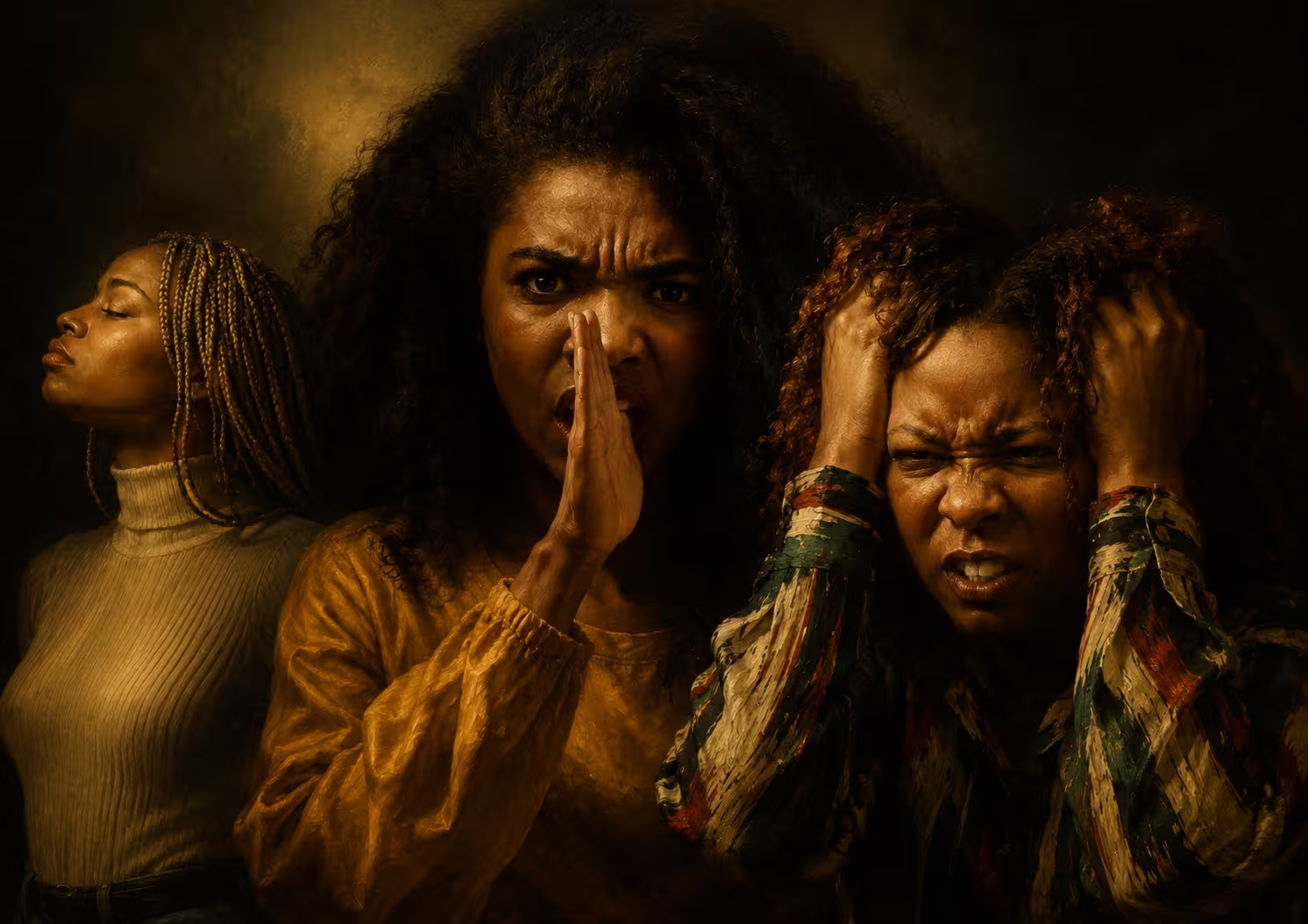
Many adults who grew up in polygamous homes describe this period as experiencing two separate losses.
The first is the death of a parent.
The second is the death of the family they thought they belonged to.
The emotional impact can be profound.
Individuals often find themselves questioning years of memories and relationships. Moments that once felt genuine are reinterpreted through the lens of inheritance battles and family politics.
Trust becomes difficult.
Some relationships never recover.
Yet not every story ends in conflict.
Across Nigeria, there are also examples of polygamous families that remain united long after the father's death.
Their success often comes down to structure.
Clear wills.
Transparent asset ownership.
Open communication.
Fair treatment of children.
Documented succession plans.
Defined responsibilities.
Families that address difficult questions before a death occurs are often better positioned to avoid destructive disputes later.
The lesson is not necessarily about whether polygamy works or fails.
It is about governance.
A family, like any institution, requires systems that can survive the absence of a single leader.
Where everything depends on one person's authority, instability becomes almost inevitable when that person is gone.
The breakdown of many polygamous households after a father's death raises broader questions about family, inheritance, and social change across Africa.
As property values rise and economic pressures increase, inheritance disputes are becoming more consequential than ever.
What previous generations managed through custom and community mediation now frequently ends up in courts.
At the same time, younger Africans are increasingly questioning family structures that rely heavily on informal arrangements and unwritten expectations.
The result is a growing tension between tradition and modern realities.
For many families, that tension only becomes visible when the patriarch dies.
Months after his father's burial, Ibrahim still remembers the moment that changed everything.
A relative stood up during a family meeting and referred to him as "that woman's son."
He looked across the room at the woman who had raised him.
The woman he called Mummy.
She said nothing.
"It wasn't the property that hurt," he says.
"It was realizing that my father wasn't the only thing I lost."
For countless Nigerians navigating life after the death of a parent, that sentence captures a painful truth.
Sometimes the funeral does not just bury a father.
Sometimes it buries the family itself.


.png)
Stay informed with the latest African media trends, job opportunities, and development news. Connecting Africa with global media and development partners.


.png)
)%20(1).png)

.avif)


)%20(3).jpg)