.png)


The 2026 FIFA World Cup group stage has revealed something far bigger than a collection of surprising results. Across North, West and Southern Africa, national teams are proving that the continent is no longer arriving to make up the numbers—it is arriving to compete deep into the tournament.
For decades, every FIFA World Cup has carried the same familiar narrative for African football. There would be hope before the tournament, flashes of brilliance during the group stage, one or two memorable upsets, and then the continent would gradually disappear as the knockout rounds began.
This year feels different.
The results alone tell an important story. But together, they point to something much bigger: African football is undergoing a structural transformation.
The conversation is no longer about whether African teams can compete with the world's elite. Increasingly, it is about how far they can go.
From the opening week of the competition, African teams refused to play the role history had assigned them.
Morocco demonstrated once again why its remarkable run to the semi-finals in Qatar four years ago was no accident. The Atlas Lions navigated a difficult group, earning a draw against Brazil before defeating Scotland and Haiti to finish top.
Egypt showed resilience against two physically demanding opponents, collecting valuable points against Belgium and Iran to secure qualification for the knockout rounds.
Cape Verde quietly became one of the tournament's biggest stories. Facing Spain, Uruguay and Saudi Arabia, the island nation remained unbeaten throughout the group stage, displaying tactical discipline that frustrated opponents expected to dominate possession.
Ivory Coast recovered from an opening defeat to Germany, regrouped under pressure and produced the performances needed to advance to the Round of 32.
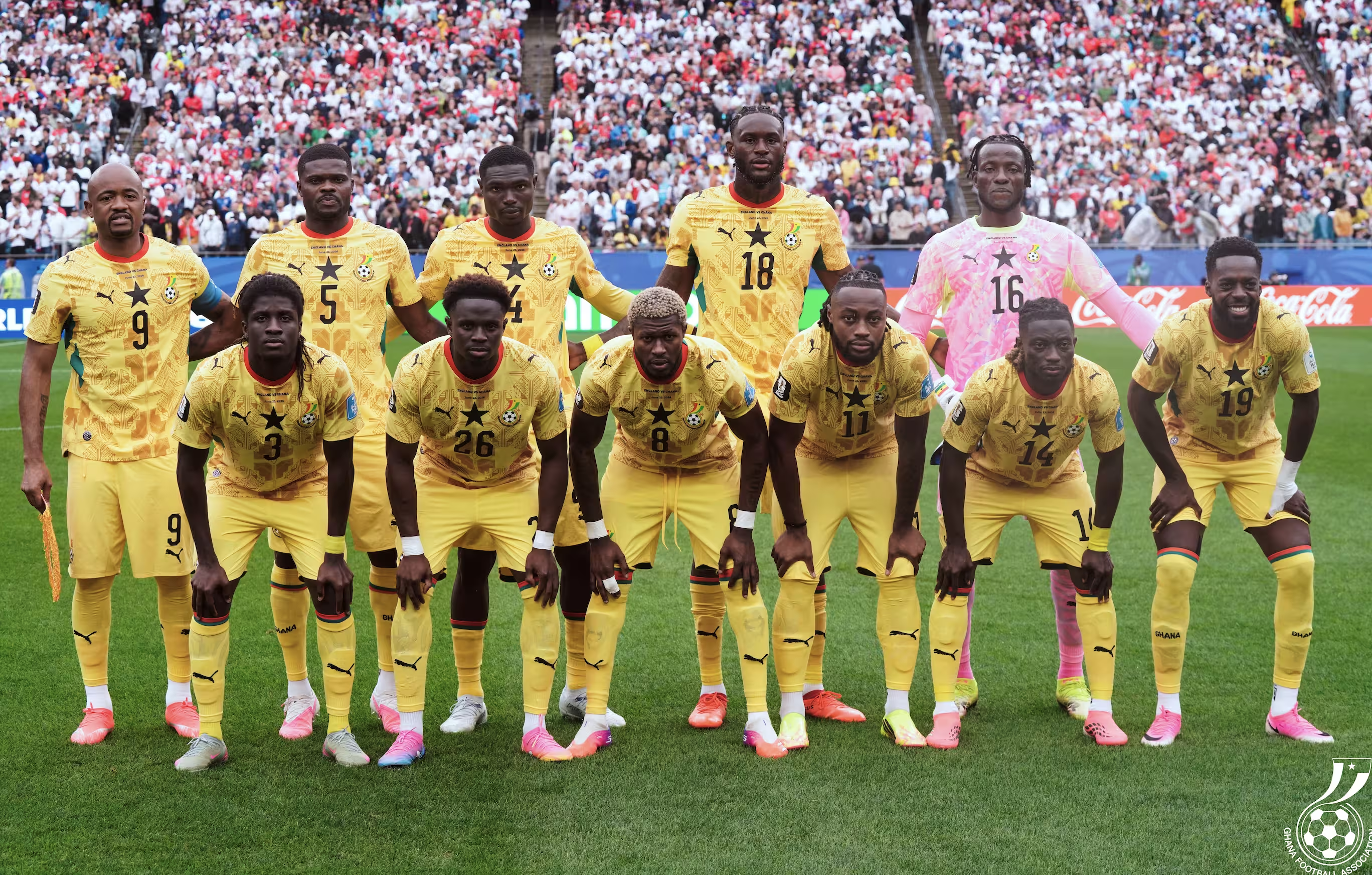
South Africa delivered one of the group's defining moments by defeating South Korea to secure qualification, while Ghana booked its place in the knockout stage before its final group fixture.
Taken individually, each result could be dismissed as an upset.
Taken together, they represent a continental shift.
There was a time when African victories over football's traditional powers were treated as fairy tales.
Today they increasingly resemble expected outcomes.
Opponents now prepare differently for African teams because they understand the challenge they present.
Modern African football combines athletic intensity with tactical organisation, technical quality and growing psychological confidence.
These are no longer teams that simply defend and counterattack.
They dominate phases of matches.
They control possession.
They dictate tempo.
They recover from setbacks.
Perhaps most importantly, they expect to win.
Confidence has become one of Africa's greatest tactical weapons.
The transformation has not happened overnight.
It has been decades in the making.
Today's African internationals are benefiting from professional academies, advanced sports science, elite coaching environments and regular competition in Europe's biggest leagues.
Players representing countries such as Morocco, Ghana, Egypt, Ivory Coast, Senegal and South Africa arrive at the World Cup having already competed in the UEFA Champions League, Premier League, Serie A, Bundesliga, La Liga and Ligue 1.
They are no longer overwhelmed by football's biggest occasions because they experience that pressure every week.
Many have captained elite clubs.
Others have won domestic league titles.
Several have played in Champions League finals.
The gap in experience that once separated Africa from Europe and South America has narrowed considerably.
One of the defining characteristics of this tournament has been the collective strength of African squads.
Morocco continues to demonstrate extraordinary defensive organisation.
Ghana's midfield has shown maturity under pressure.
Egypt remains tactically disciplined.
Ivory Coast possesses remarkable physical depth.
South Africa has developed a resilient team identity.
Cape Verde has become one of the tournament's most organised defensive units.
Success is increasingly built on systems rather than individual brilliance.
That evolution is perhaps African football's biggest achievement.
History reminds us that Africa has been here before.
Cameroon reached the quarter-finals in 1990.
Senegal repeated the feat in 2002.
Ghana came within a penalty kick of the semi-finals in 2010.
Morocco finally broke through in 2022, becoming the first African nation to reach the FIFA World Cup semi-finals.
Each generation pushed the ceiling a little higher.
The question now is whether this generation can raise it again.
With multiple African nations entering the knockout rounds carrying confidence, organisation and genuine belief, the possibility no longer feels unrealistic.
The significance extends beyond sport.
Every strong World Cup performance strengthens the reputation of African football, attracts greater investment, inspires young players across the continent and challenges outdated perceptions about Africa's place in global sport.
The World Cup remains football's biggest stage.
For generations, African nations fought for recognition there.
Today, they are competing for something far greater.
Respect has largely been earned.
Now the continent is chasing history.
And based on everything witnessed during the group stage, Africa did not come to participate.
It came to contend for football's greatest prize.


.png)
Stay informed with the latest African media trends, job opportunities, and development news. Connecting Africa with global media and development partners.
.png)
.jpeg)
.avif)
.avif)
.avif)