.png)


Every four years, the FIFA World Cup reminds the world that football is the most popular sport on Earth.
Billions watch.
Millions travel.
Governments celebrate.
Brands spend fortunes.
Players become heroes.
Yet behind the spectacle lies a question that few football fans ever ask:
Who actually makes the money?
For Africa, that question is particularly important.
The continent has become one of football's greatest producers of talent. African players dominate some of the world's biggest leagues, African heritage runs through many elite national teams, and African fans represent one of football's fastest-growing audiences.
Yet despite its enormous contribution to the game, Africa captures only a small fraction of football's economic value.
The World Cup is often presented as a sporting event.
In reality, it is one of the largest entertainment businesses on the planet.
And Africa remains one of its most important suppliers.
Most fans assume football wealth comes from ticket sales.
That is no longer true.
Modern football is powered by television rights, sponsorship deals, merchandising, digital subscriptions, betting companies, player transfers, streaming platforms and global advertising.
The biggest European leagues generate billions of dollars annually through broadcasting agreements alone.
Clubs earn money from shirt sponsorships, licensing deals, international tours, digital content and commercial partnerships.
A football club is no longer just a sports team.
It is a global media company.
The World Cup itself generates billions in commercial revenue through broadcasting rights, sponsorship agreements and licensing partnerships.
Football is no longer simply a game.
It is an economy.
Walk through football history and a pattern quickly emerges.
Many of the world's most exciting players either come directly from Africa or have African roots.
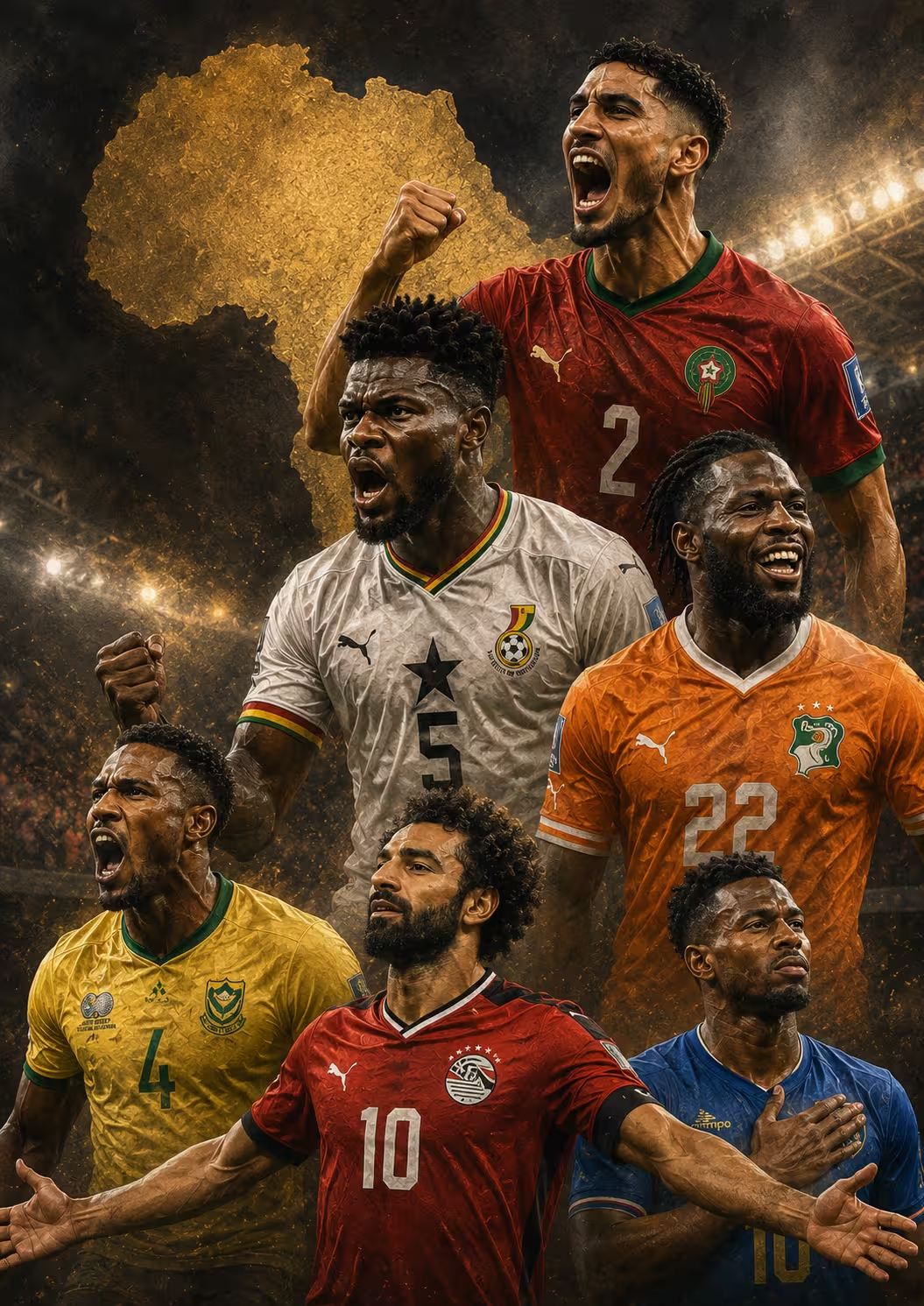
From Mohamed Salah and Victor Osimhen to Achraf Hakimi and Ademola Lookman, African talent continues to shape the modern game.
Across Europe, scouts regularly search African countries for the next generation of stars.
Young players are recruited into academies, developed through professional systems and eventually sold into larger leagues.
For many athletes, football offers opportunities that would otherwise be impossible.
Families are transformed.
Communities benefit.
Dreams become reality.
But while individual players succeed, the broader economic structure tells a different story.
The talent often originates in Africa.
The wealth is often generated elsewhere.
This may be the most important distinction in global football.
Africa exports players.
Europe exports football itself.
Europe owns many of the world's most valuable clubs.
Europe owns many of the world's most lucrative leagues.
Europe controls much of the broadcasting infrastructure that distributes football worldwide.
Europe hosts many of the commercial partnerships that generate football's largest revenues.
As a result, the continent that supplies much of the talent does not necessarily control the industry's most profitable assets.
This is not unique to football.
For decades, many African economies have exported raw materials while importing finished products.
Football often follows a similar pattern.
Africa exports talent.
Others monetize the ecosystem.
One of the most significant developments in modern football has been the explosion of sports betting.
Across Africa, betting companies have become major advertisers during football tournaments.
Millions of fans place wagers every week.
The World Cup typically accelerates this activity.
For many businesses, football is no longer just entertainment.
It is customer acquisition.
The relationship between football and betting has created a new layer of economic activity around the sport.
The challenge is that while betting generates significant revenues, much of the value leaves local economies through multinational operators and international technology platforms.
This creates another important question:
How much of football's financial ecosystem is actually owned by Africans?
Imagine a different scenario.
Imagine African investors owning globally competitive football clubs.
Imagine African media companies controlling major football rights.
Imagine African technology firms building sports platforms used around the world.
Imagine African-owned academies becoming global talent factories.
Imagine football becoming a major export industry controlled from African cities rather than merely supplying talent to foreign systems.
The opportunity is larger than sport.
Football influences tourism, media, technology, advertising, entertainment and national branding.
Countries that control football assets often benefit far beyond the pitch.
The conversation about African football usually focuses on one question:
When will Africa win the World Cup?
It is an important question.
But it may not be the most important one.
Another question deserves equal attention:
When will Africa own a larger share of the football economy?
Winning a World Cup would be historic.
Owning more of football's commercial ecosystem could be transformational.
The future of African football may depend not only on producing better players but also on building stronger institutions, smarter businesses and more valuable football assets.
The continent has already proven it can produce world-class talent.
The next challenge is capturing more of the value that talent creates.
Africa has become one of football's most important talent factories.
Yet talent alone does not create lasting wealth.
Ownership does.
Infrastructure does.
Media rights do.
Technology does.
The countries and companies that control football's ecosystem often benefit far more than those who merely participate in it.
As the World Cup approaches, millions will focus on goals, trophies and glory.
But beneath the excitement lies a bigger story.
Africa is helping power one of the world's largest sporting industries.
The question is whether it is capturing enough of the rewards.
World Cup Files | Edition 002
Africa Reporters Network
Decoding Africa. Telling Our Stories. Shaping Our Future.
Tags: African football, World Cup 2026, football economy, African football players, football business, sports betting Africa, football broadcasting rights, football wealth, African sports industry, FIFA World Cup Africa


.png)
Stay informed with the latest African media trends, job opportunities, and development news. Connecting Africa with global media and development partners.
.avif)
.jpeg)
.png)
.avif)