.png)


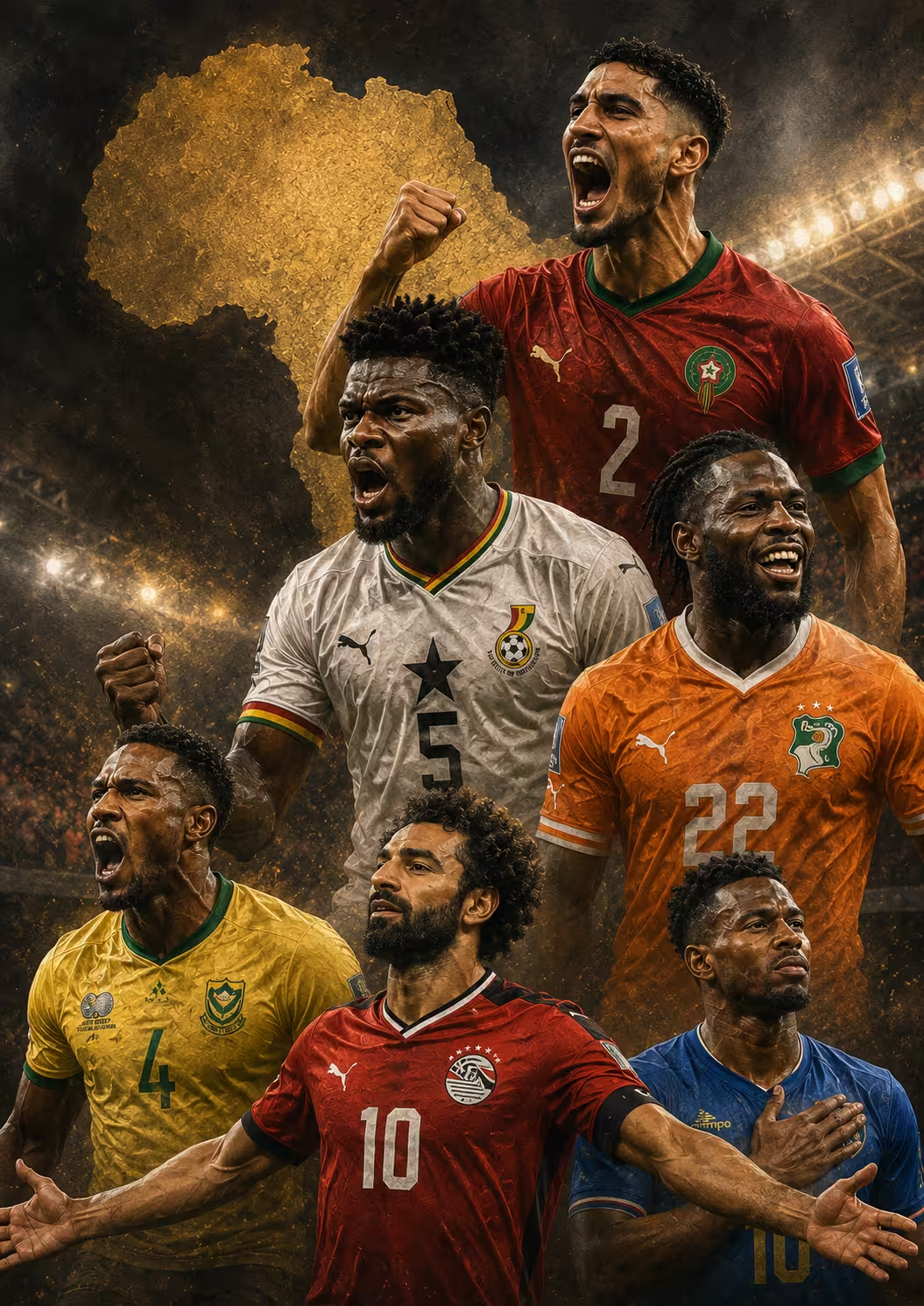
On Friday night in Kansas City, Ghana will play Colombia for a place in the last sixteen of the World Cup. It is the Black Stars' first knockout match since 2010, and for at least ninety minutes a nation of more than thirty million people will hold its breath.
The question that matters is not the one dominating most previews. It is not whether Ghana can match Colombia for pace, organisation or individual quality. The evidence of four decades suggests African teams rarely leave World Cups because they lack talent. They leave because knockout football finds the crack that group football forgives. That crack is composure.
Since 1986, six African nations have reached the knockout rounds of a World Cup: Morocco, Cameroon, Nigeria, Senegal, Ghana and Algeria. Through 2022 they produced eleven knockout appearances between them. One reached a semifinal, Morocco in 2022. None has reached a final.
This tournament has already rewritten part of that story. Seven African teams advanced from the group stage of the expanded 2026 format, the strongest collective showing in the continent's World Cup history. Depth is no longer the problem. Qualification is no longer the ceiling. What remains unbroken is the pattern at the next stage, where a single evening decides everything and the margin between progress and elimination is measured in seconds of concentration.
Consider the two most painful nights in African World Cup history.
Italy, 1990. Cameroon lead England 2 to 1 in a quarterfinal with less than ten minutes remaining. The semifinal is visible. Then a rash challenge concedes a penalty. In extra time, another. Cameroon lose 3 to 2, not outplayed but undone by the rush to finish a job that patience would have completed.
Johannesburg, 2010. The last kick of extra time. Luis Suarez stops a certain Ghana goal with his hand on the line and is sent off. Asamoah Gyan, who had scored twice from the spot earlier in the tournament, strikes the penalty against the crossbar. Ghana lose the shootout, and Africa's first World Cup semifinal slips away by centimetres.
Different eras. Different teams. The same ending, decided in the same place: not the legs, the mind.
Ghana has already been shown the lesson at this tournament. Against Croatia in Philadelphia, the Black Stars fought back through Derrick Luckassen to stand seventeen minutes from an unbeaten group stage and second place in Group L. Then one late corner. One man lost his marker. Nikola Vlasic's header won the match 2 to 1, dropped Ghana to third and handed Croatia the easier route.
Luckassen said afterwards that scoring meant little beside the disappointment of the defeat, and he was right to frame it that way. The goal was earned over seventy minutes. The loss took four seconds. Knockout football does not forgive that second twice.
Here is what the pattern actually looks like from inside a match, because it never announces itself as panic.
Concentration does not disappear all at once. It leaks. A glance at the clock. A thought about the score. A defender replaying the last duel instead of watching the next run.
A striker who scores a chance every morning in training misses the same chance in the match not because he forgot how to finish, but because the moment feels too big. He is not missing technique. He is hearing a nation inhale.
Impatience is fear wearing a work rate. When a team starts forcing passes that were never there, it is not urgency. It is players who have become afraid to wait.
And when a teammate makes a mistake, silence hurts him more than any shout. Support that arrives only when things are going well is not support. It is scorekeeping. Championship teams encourage loudest in the exact moment after an error, because they understand a simple accounting: energy spent on blame is energy taken from the match.
The Black Stars must become emotionally lighter as the tournament becomes heavier. Every setback must become information, not panic. Pressure is not the enemy. Poor reactions to pressure are.
There are reasons for belief beyond hope. This squad has already produced the most disciplined group stage performance Ghana has managed in five World Cup appearances: a controlled win over Panama and a goalless draw with England built on structure and patience. Carlos Queiroz has spent a coaching lifetime organising teams to survive occasions bigger than themselves, and his emphasis on recovery and calm preparation this week reflects that experience.
The squad's own voice matters here too. Brandon Thomas Asante has spoken of a group hungry to make a name for itself at this tournament, and that hunger has so far expressed itself as discipline rather than desperation. The task in Kansas City is to keep it that way when the match tightens.
Colombia deserve respect. They topped their group and arrive with momentum and genuine attacking quality. But teams of Colombia's profile lose knockout matches regularly, to opponents who defend with concentration, strike efficiently and refuse to unravel. Nothing about that description is beyond this Ghana side.
One game. Ninety minutes, perhaps more. No second chances.
If Ghana loses on Friday, the full time whistle will not be the real story. The real story will have happened earlier, in some small moment when heads dropped, when a pass was forced, when a teammate was left alone with his mistake. And if Ghana wins, the same will be true in reverse.
The knockout stage is not simply a test of football ability. It is a test of collective composure. The obstacle between the Black Stars and the last sixteen may not be the opponent across the pitch. It may be the ability to master the emotions within.
That is the question Kansas City will ask. Sixteen years is long enough to prepare an answer.


.png)
Stay informed with the latest African media trends, job opportunities, and development news. Connecting Africa with global media and development partners.
.avif)
.avif)
.png)
.avif)
.jpeg)