.png)


Something unusual is happening at this World Cup.
Not because an African team has won the tournament.
Not because Africa has suddenly produced talented footballers.
Africa has always produced talented footballers.
What's changing is something deeper.
The results are beginning to match the talent.
And the football world is starting to notice.
For years, African football lived inside a contradiction. Europe's biggest clubs trusted African players. Europe's biggest national teams feared African players. Yet when the World Cup arrived, African nations were still spoken about as outsiders—dangerous, exciting, unpredictable outsiders, but outsiders nonetheless.
That narrative is becoming harder to defend.
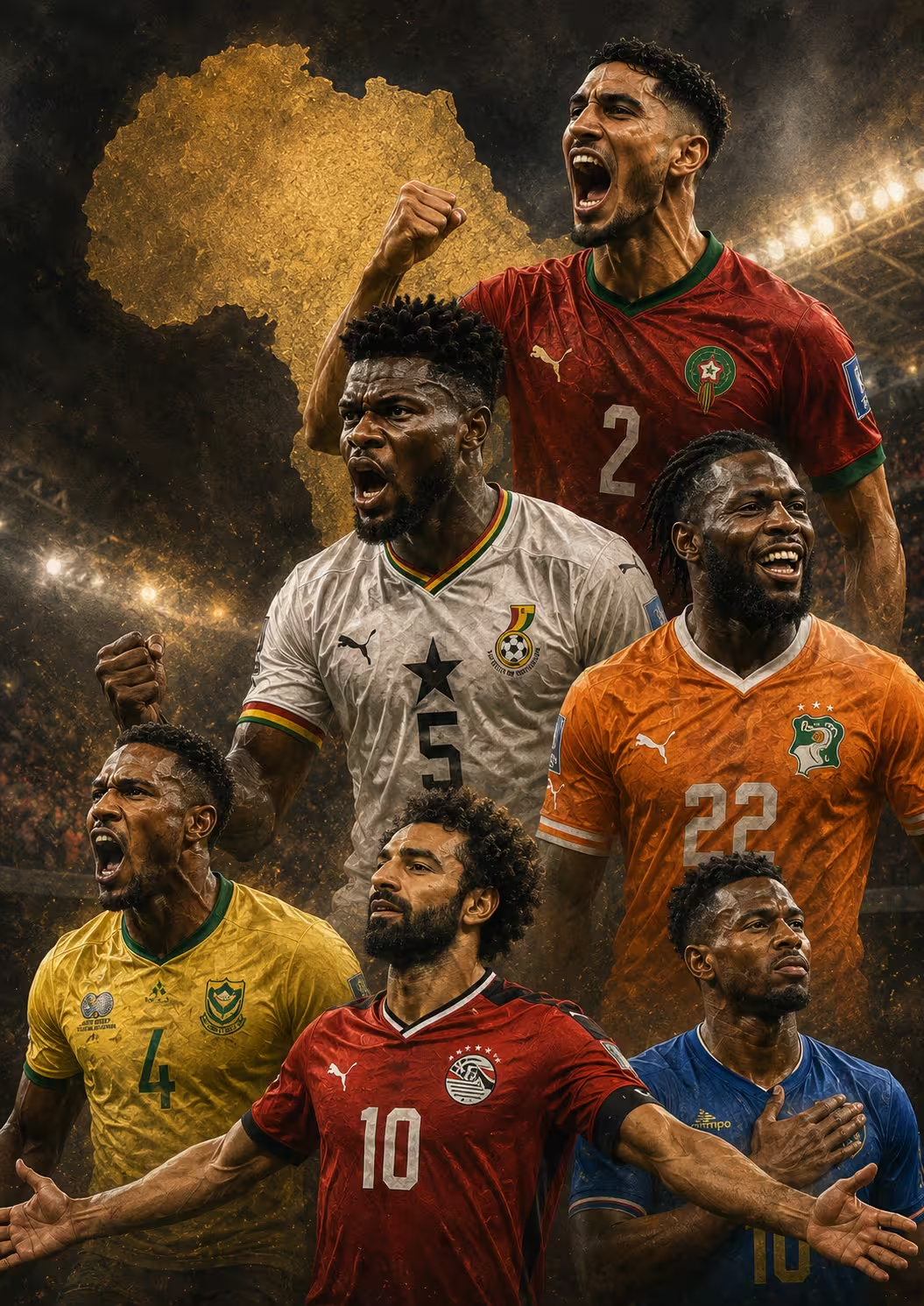
Morocco held Brazil.
Egypt held Belgium.
Cape Verde held Spain.
Ivory Coast defeated Ecuador.
DR Congo held Portugal.
Individually, each result can be dismissed as football being football.
Together, they tell a different story.
They suggest that African football may be entering a new era.
For decades, global football operated on an accepted hierarchy.
Europe sat at the top.
South America sat beside it.
Everyone else competed for respect.
African teams were often praised for passion, athleticism and raw talent. Yet the praise frequently came with a hidden assumption: that Africa could entertain but not dominate.
That assumption is now facing its toughest challenge.
Modern African football looks different from the version the world became comfortable with.
Players are no longer arriving in elite leagues as exceptions.
They are arriving as expectations.
From the Premier League to La Liga, from Serie A to the Bundesliga, African players have become central figures rather than supporting characters.
The world's best clubs increasingly depend on African talent.
The natural question follows:
If Africa's players are good enough to shape elite club football, why shouldn't African teams shape elite international football?
Part of the answer lies in a generational shift.
Today's African footballers are developing in environments previous generations could only imagine.
Many are competing weekly at the highest levels of the game.
They face world-class opponents every weekend.
They work with elite coaches.
They understand modern tactical systems.
They play under pressure.
They are no longer intimidated by famous shirts because they spend their careers playing alongside or against the players wearing them.
The psychological gap that once separated traditional football powers from emerging nations is shrinking.
And football has always been as much psychological as technical.
The easy explanation for Africa's recent performances is talent.
The better explanation is structure.
For years, African football's biggest challenge was not producing gifted players. It was building the systems required to maximize them.
The gap between Africa and football's traditional powers was rarely about individual ability.
It was about infrastructure.
Planning.
Coaching.
Administration.
Sports science.
Long-term development.
The encouraging signs emerging at this World Cup suggest progress in those areas.
Not everywhere.
Not equally.
But enough to change results.
Enough to change perceptions.
Enough to change expectations.
Many observers point to Morocco's historic 2022 World Cup run as the turning point.
Before Morocco reached the semi-finals, African success was often discussed as a possibility.
After Morocco reached the semi-finals, it became a precedent.
The difference matters.
Possibilities inspire.
Precedents convince.
Morocco demonstrated that an African nation could navigate the tactical, psychological and physical demands required to compete deep into a World Cup.
That achievement altered how Africa viewed itself.
It also altered how the football world viewed Africa.
The 2026 tournament increasingly feels like the continuation of that story rather than an isolated chapter.
Football rarely exists in isolation.
The conversations surrounding African football often mirror larger conversations about Africa itself.
For decades, the continent has supplied talent to the world.
Athletes.
Artists.
Entrepreneurs.
Engineers.
Writers.
Innovators.
The challenge has never been human potential.
The challenge has been transforming potential into sustained influence.
Football is simply making that transformation visible.
When African teams compete confidently against traditional powers, they challenge more than sporting assumptions.
They challenge old ideas about where excellence can come from.
And who gets to define it.
The most revealing sign of Africa's rise may not be the results themselves.
It may be the reactions to them.
For years, strong African performances were treated as surprises.
Today they are increasingly treated as evidence.
Evidence that African football has evolved.
Evidence that old assumptions are becoming outdated.
Evidence that the gap is narrowing.
Perhaps not everywhere.
Perhaps not permanently.
But undeniably.
The world is no longer asking whether African teams can compete.
It is beginning to ask how far they can go.
Africa has always influenced world football.
The difference today is that the influence is becoming harder to separate from the results.
For decades, the continent exported talent while others collected trophies.
That equation is beginning to change.
Slowly.
Unevenly.
But unmistakably.
The story of this World Cup may not ultimately be who wins it.
It may be that Africa is no longer being invited into football's top conversation.
Africa is becoming impossible to leave out of it.
And if the early signs of this tournament continue, the future of world football may look far more African than many people expected.
World Cup Files | Edition 006
Africa Reporters Network
Decoding Africa. Telling Our Stories. Shaping Our Future.
Tags: African football, FIFA World Cup 2026, Morocco Brazil, Egypt Belgium, Ivory Coast Ecuador, African teams World Cup, Africa football development, World Cup Files, Africa Reporters Network, African football rise.


.png)
Stay informed with the latest African media trends, job opportunities, and development news. Connecting Africa with global media and development partners.
.avif)
.avif)
.png)
.jpeg)