
.png)


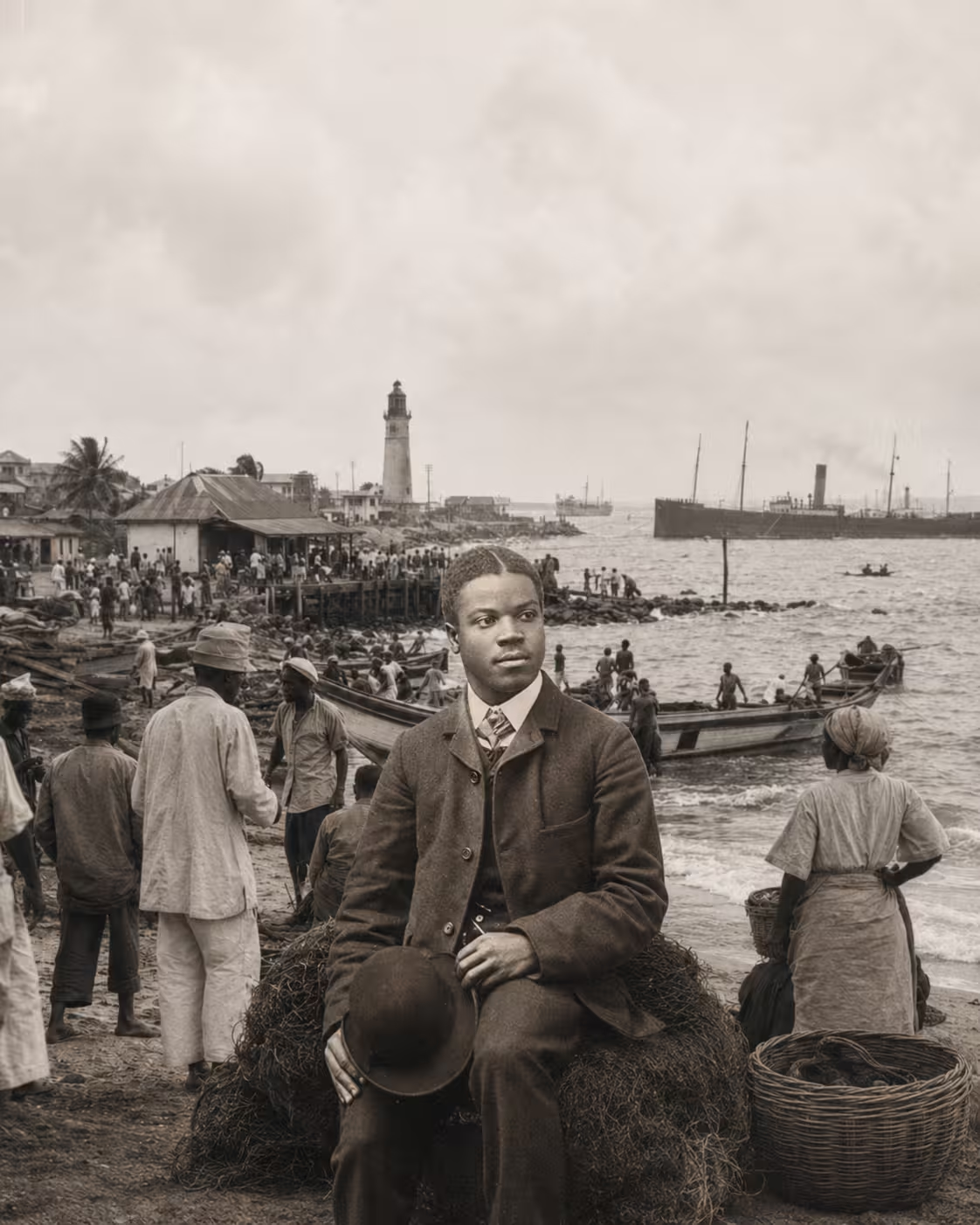
In October 1885, a young African clerk working inside the colonial government in Accra lost his job.
His offence was political.
He had taken part in the Accra riots.
He was about 20 years old.
His name was Thomas Hutton-Mills.
At birth, he had been named Korle Na.
Losing that government position could easily have ended the ambitions of a young man living under colonial rule.
Instead, it pushed Hutton-Mills towards the profession that would make him one of the most influential African political figures of his generation.
Law.
Within a decade, he would qualify as a barrister in Britain and return to Accra.
Within another few years, he would enter the Gold Coast Legislative Council.
And by 1920, he would become the first president of an organisation trying to coordinate African political demands across the Gold Coast, Nigeria, Sierra Leone and The Gambia.
This was decades before Kwame Nkrumah.
Before the Convention People’s Party.
Before the 1948 disturbances.
Before Ghana.
Yet the argument had already begun.
Who should control African land?
Who should represent Africans in government?
Should Africans be appointed by colonial officials or elected by the people themselves?
And who had the right to speak for a society under foreign rule?
Thomas Hutton-Mills spent much of his life inside those arguments.
This is Chapter Three of Accra Before Ghana.
Thomas Hutton-Mills was born in June 1865.
His father was John Edward Hutton-Mills.
His mother was Emma Bannerman, the daughter of James Bannerman, who had served as lieutenant-governor of the Gold Coast settlement in 1850 and 1851.
That Bannerman connection is important.
By the time Thomas was born, his family was already connected to commerce, colonial administration and the growing educated African class of nineteenth-century Accra.
He was educated at the Duker School in Accra and later at the Wesleyan School in Freetown, Sierra Leone.
In 1881, he returned to the Gold Coast.
His first profession was not law.
He became a teacher at the Johnson School in Accra.
Then he entered the colonial civil service.
That decision brought him directly inside the machinery of British government.
And eventually into conflict with it.
Hutton-Mills first worked in the customs branch of the Gold Coast civil service.
But he wanted to study law.
So he transferred to the Law Officers’ Department and worked under the Queen’s Advocate.
There he gained direct exposure to the colonial legal system.
He saw how cases were prepared.
How government used law.
How disputes were decided.
How power was translated into statutes, courts and legal procedure.
For a young African clerk, this was valuable training.
But in October 1885, his government career abruptly ended.
Hutton-Mills was dismissed for participating in political unrest in Accra.
The episode is revealing.
His political instincts appeared before his legal career.
And once the colonial government pushed him out of public service, he moved towards the profession that would eventually give him an independent platform from which to confront government policy.
He went to work as chief clerk in the law office of his uncle, Edmund Bannerman.
Then came Britain.
In 1891, Thomas Hutton-Mills travelled to England to study law at the Inner Temple.
He was called to the Bar in 1894.
On his journey back to West Africa, he stopped in The Gambia, where he was enrolled as a legal practitioner.
For a brief period, it appeared he might build his career there.
He changed his mind.
He returned to Accra.
He also practised for a period in Calabar, in present-day Nigeria, before finally settling into legal practice in the Gold Coast capital.
Back home, his influence grew quickly.
His house became a meeting place for politicians.
His legal practice expanded.
And he developed a reputation as a careful lawyer who studied his cases thoroughly and treated clients and opponents with courtesy.
But law in the Gold Coast was becoming political.
One issue above all others made that clear.
Land.
In the late nineteenth century, land became one of the defining political questions of the Gold Coast.
The British colonial government introduced proposals that many Africans believed threatened indigenous ownership.
The most famous resistance came through the Aborigines’ Rights Protection Society, established in Cape Coast in 1897.
The organisation challenged attempts to expand colonial control over land.
One of the most controversial proposals was the Lands Bill of 1897.
If enacted in its original form, African political leaders feared it could undermine customary land tenure and strengthen government control.
Thomas Hutton-Mills became one of the lawyers representing petitioners opposing the bill.
That placed him inside one of the earliest organised political struggles against colonial policy in the Gold Coast.
The campaign succeeded.
The proposed law was not enacted in the form its opponents feared.
And in 1898, Hutton-Mills entered the Legislative Council as an unofficial African member.
He had gone from being dismissed as a young colonial clerk to participating in the institution that helped make colonial law.
The transformation had taken barely 13 years.
In 1900, Hutton-Mills faced a serious professional crisis.
He was charged with misconduct as a lawyer.
The accusation forced him to resign from the Legislative Council.
It could have permanently destroyed his reputation.
But he was tried and acquitted.
The evidence showed that one of his clients had given false testimony against him.
His political career eventually recovered.
In 1909, Hutton-Mills returned to the Legislative Council.
He remained there until 1918.
That second period would establish him as one of the sharpest African critics of colonial government.
Hutton-Mills was known as a persuasive debater.
He pushed for recognition of the Aborigines’ Rights Protection Society as an organisation capable of speaking for African interests.
He also joined opposition to another controversial colonial proposal:
the Forest Lands Bill of 1911.
Again, the central issue was control over land and natural resources.
Again, African leaders feared that colonial legislation could weaken indigenous rights.
The bill was eventually withdrawn.
These battles show why early Gold Coast politics cannot be reduced simply to the final struggle for independence.
Before Africans demanded complete political sovereignty, they were already fighting over something fundamental:
Who owned the land?
Who could legislate over it?
What authority did colonial government have over African institutions?
Those questions were already shaping politics decades before 1957.
By 1917, Hutton-Mills was working with J. E. Casely Hayford and others on an ambitious political project.
They wanted representatives from Britain’s West African colonies to meet and discuss problems they shared.
The territories included:
The Gold Coast.
Nigeria.
Sierra Leone.
The Gambia.
They also involved traditional leaders in the early discussions, including Nana Ofori Atta I, Omanhene of Akyem Abuakwa.
But Ofori Atta later opposed the movement.
That disagreement would become important.
Because the new political organisation was about to expose a deep question inside African politics:
Should political power belong increasingly to educated professionals?
Or should traditional rulers remain the main representatives of African society?
That question would divide African leaders.
And Thomas Hutton-Mills would end up on one side of it.
In 1920, the National Congress of British West Africa emerged as one of the most important African political organisations of the early colonial period.
Thomas Hutton-Mills became its first president.
The organisation pushed for constitutional reform and greater African participation in colonial government.
Among its major demands was popular election to the Legislative Council.
That idea deserves context.
Today, elections appear inseparable from government.
But under colonial rule, African representation was heavily restricted and often based on appointment.
Hutton-Mills wanted Africans to have a greater role in choosing who represented them.
The Congress also pushed for educational development and greater African participation in public administration.
It was not yet demanding immediate independence.
That political language would come later.
But something important had changed.
Africans were organising across colonial borders and making collective political demands.
Hutton-Mills joined a Congress delegation that travelled to London in 1920.
They wanted to present their concerns directly to the British government.
The Colonial Secretary, Lord Milner, refused to grant them an audience.
The delegation did, however, meet the League of Nations Union, chaired by the classical scholar Gilbert Murray.
Hutton-Mills participated actively in those discussions.
There is something deeply revealing about the episode.
The British Empire had created institutions in which Africans could study.
It had trained African lawyers.
It employed African clerks.
It spoke constantly about civilisation and political development.
But when some of those educated Africans organised themselves and asked for a greater political voice, the Colonial Secretary would not even receive them.
Again, the limit became visible.
Education was acceptable.
African political power was more complicated.
As president of the National Congress of British West Africa, Hutton-Mills argued for popular elections to the Legislative Council.
This placed him in conflict with another influential political philosophy developing under Governor Sir Gordon Guggisberg.
Guggisberg favoured a system of native administration that strengthened the authority of paramount chiefs.
Hutton-Mills opposed this direction.
He feared that strengthening chiefs within a structure ultimately controlled by colonial government could limit the development of direct political representation.
This was not simply an argument between Africans and Europeans.
Africans themselves disagreed.
Some traditional leaders believed the Congress was dominated by educated professionals who had no right to claim they represented African society.
Some educated politicians believed rule through chiefs could be used by colonial government to prevent broader democratic participation.
The argument was fundamental.
Who represents the people?
The chief?
The lawyer?
The elected politician?
The colonial appointee?
Ghana would continue wrestling with versions of that question long after independence.
Hutton-Mills did not restrict his public work to elections and land.
From 1918, he was among those pressing for the creation of a government secondary school in the Gold Coast.
Members of the Aborigines’ Rights Protection Society also developed a National Education Scheme to expand secondary education.
Hutton-Mills became one of its trustees.
Eventually, Achimota College opened in 1927.
Its creation resulted from several forces and personalities, but the earlier agitation for expanded secondary education formed part of the political environment that made such an institution increasingly necessary.
Hutton-Mills also served on the Board of Education, where several of his recommendations were accepted by government.
This tells us something important about his generation.
They understood political advancement and education as connected.
If Africans were going to participate meaningfully in government, commerce and the professions, they needed institutions capable of training them.
Political representation required intellectual infrastructure.
Hutton-Mills was also deeply involved in the Anglican Church.
He became Chancellor of the Diocese of the Anglican Church of the Gold Coast.
He supported Holy Trinity Church in Accra, including donating a pipe organ.
Today, these details may appear separate from politics.
In old Accra, they were not.
Churches were important institutions of education, social organisation and elite networks.
Families met there.
Professionals worshipped there.
Schools grew from missionary organisations.
Social clubs connected merchants, lawyers, civil servants and politicians.
Religious institutions were part of the architecture through which the emerging African professional class organised itself.
Hutton-Mills also became a patron of literary and social organisations and helped establish the Rodger Club, an African social club named after Governor John Pickersgill Rodger.
The club elected him chairman.
His world stretched across law, politics, education, church and social life.
And then there was sport.
In 1905, Thomas Hutton-Mills played cricket for the Gold Coast against Nigeria.
He was also a keen tennis player.
The detail may seem minor.
It is not.
It allows us to see the man beyond the Legislative Council.
The Africans emerging into professional life in early twentieth-century Accra did not exist only inside courtrooms and political meetings.
They belonged to clubs.
Played sport.
Attended church.
Hosted meetings in their homes.
Built friendships and rivalries.
Married into other families.
Created newspapers.
Established businesses.
The political class of old Accra was also a social world.
And once we begin following those relationships, one family name leads directly into another.
Thomas Hutton-Mills was the son of Emma Bannerman.
Her father was James Bannerman, one of the most consequential African figures in nineteenth-century Accra.
James Bannerman had been a merchant and colonial administrator and briefly served as lieutenant-governor of the Gold Coast settlement.
Other members of the Bannerman family went into law and journalism.
Thomas later worked for his uncle Edmund Bannerman before leaving for Britain.
So the Hutton-Mills story cannot be separated completely from the Bannerman story.
Then another connection appears.
Marriage.
Thomas Hutton-Mills married into the Nanka-Bruce family.
And suddenly our map of old Accra becomes considerably more interesting.
Frederick Victor Nanka-Bruce would become one of the leading African physicians in twentieth-century Accra.
He was also a politician and newspaper proprietor.
His sisters became connected by marriage to Thomas Hutton-Mills.
Now look at the emerging network.
Hutton-Mills.
Law and politics.
Bannerman.
Commerce, law, newspapers and colonial administration.
Nanka-Bruce.
Medicine, journalism and politics.
Quartey-Papafio.
Medicine, law, commerce and Ga scholarship.
These were not disconnected biographies.
Families married.
Lawyers worked together and against one another.
Doctors entered politics.
Homes became political meeting places.
Newspapers carried their arguments.
Churches and schools connected their households.
Accra’s emerging African professional class was developing through networks.
That does not mean these families alone created the city.
Far from it.
Accra was also being built every day by fishermen, market women, artisans, labourers, farmers, traders and families whose names rarely entered colonial records.
But these professional families occupied strategic positions inside the institutions through which political and economic influence was increasingly exercised.
Understanding them helps us understand how power was developing inside the city.
Hutton-Mills’s home in Accra became known as a meeting place for politicians.
That detail may be one of the most revealing of all.
Before political party headquarters.
Before conference centres.
Before radio studios.
Before modern campaign offices.
Politics often happened in homes.
People gathered.
Arguments developed.
Petitions were written.
Alliances formed.
Ideas travelled.
A house could become an institution.
Old Accra was full of such spaces.
Family compounds.
Law chambers.
Newspaper offices.
Churches.
Schools.
Trading houses.
And social clubs.
The political infrastructure of the city was growing long before Ghana had formal democratic institutions.
When Hutton-Mills left the Legislative Council in 1918, King George V, acting on the recommendation of Governor Sir Hugh Clifford, allowed him to retain the title “Honourable” for life.
It was recognition from the same imperial system he had spent years criticising.
That apparent contradiction captures something about his generation.
These men were not yet operating outside colonial institutions.
They were operating through them.
Challenging them.
Negotiating with them.
Seeking reform from within them.
Their politics would later look cautious compared with the mass nationalism of the 1940s and 1950s.
But political movements rarely begin with their most radical demand.
They develop.
Hutton-Mills belonged to an earlier phase.
The generation that was still forcing open the door.
Thomas Hutton-Mills died on March 14, 1931.
He was 65.
Ghanaian independence was still 26 years away.
He never saw the country that eventually emerged.
He never saw universal adult suffrage.
He never saw an African prime minister govern the Gold Coast.
He never saw Ghana’s flag.
But the political questions that would eventually lead to those things had already occupied much of his life.
African representation.
Land rights.
Education.
Constitutional reform.
Popular elections.
The relationship between traditional authority and modern government.
These were not questions Ghana suddenly discovered at independence.
Accra had been arguing about them for generations.
And Thomas Hutton-Mills was one of the men in the room.
By Chapter Three of Accra Before Ghana, something is becoming clearer.
The history of old Accra cannot be told properly through isolated biographies.
Benjamin Quartey-Papafio leads us to Arthur.
Arthur leads us into law and Ga customary authority.
Thomas Hutton-Mills leads us into the Bannermans.
The Hutton-Mills marriage leads us toward the Nanka-Bruces.
The Nanka-Bruces will lead us towards another family:
the Reindorfs.
Then medicine meets history.
James Town meets Osu.
Politics meets journalism.
And Accra begins revealing itself not as a collection of individual success stories, but as a web of families, institutions and neighbourhoods influencing one another across generations.
That is the Accra we are looking for.
The Accra before Ghana.


.png)
Stay informed with the latest African media trends, job opportunities, and development news. Connecting Africa with global media and development partners.
.png)
.png)
.webp)
)%20(4).jpg)
.avif)
)%20(2).jpg)
%20(1).avif)